Wearables and smart devices help amateur and professional athletes measure performance, health, and recovery by continuously tracking key metrics like heart rate, workload, sleep, and stress. The value is not in raw numbers, but in consistent data, context (training, travel, stress), and simple decision rules that adjust training and recovery in real time.
Essential Performance and Recovery Metrics
- Heart rate (HR) and heart rate variability (HRV) to monitor internal load and recovery status.
- Mechanical load via GPS, accelerometers, and power meters to quantify external work.
- Sleep duration, efficiency, and timing to support recovery and adaptation.
- Respiration, skin or core temperature, and SpO2 for health and acute stress monitoring.
- Subjective wellness markers (RPE, fatigue, soreness) recorded alongside device data.
- Trends and baselines over weeks, not single isolated measurements, guiding decisions.
Choosing Wearables: sensors, form factors and validation
Wearables and smart devices for sports are essentially sensor platforms attached to the body, collecting physiological and mechanical data during daily life and training. For athletes in Brazil using a relógio inteligente esportivo para monitorar desempenho, the critical question is not only which device, but which sensors, accuracy, and ecosystem they actually need.
Common form factors include watches, rings, chest straps, arm straps, cycling head units, and a pulseira fitness profissional para saúde e performance. Watches and rings are ideal for 24/7 tracking, while chest straps and bike power meters are usually reserved for sessions where precision during effort matters more than comfort.
Optical sensors (PPG) in wrist wearables estimate HR and HRV using light; they are convenient but can struggle with rapid arm movement, dark tattoos, or loose fitting. Chest straps rely on electrical signals (ECG-like) and are typically more accurate for high-intensity intervals, sprints, and change-of-direction sports.
When evaluating dispositivos smart para avaliação de performance esportiva, look for at least minimal validation against gold-standard methods (lab ECG, motion capture, metabolic carts). Independent reviews and small academic studies are more informative than marketing claims. For most intermediate athletes, "good enough and consistent" is preferable to the theoretically "perfect" but fragile device.
Mini-scenarios:
- Recreational runner in São Paulo: chooses the melhor smartwatch para corrida e treino funcional with GPS + optical HR for road runs, adding a chest strap only for interval days.
- Professional volleyball player: uses a light wristband for daily HRV and sleep, plus indoor position/accelerometry systems provided by the club for jump load and landing impacts.
- Triathlete: combines a multisport watch, cycling power meter, and a swim HR sensor to monitor all three disciplines with consistent data fields.
Core physiological metrics: HR, HRV, SpO2, respiration and temperature
- Heart Rate (HR)
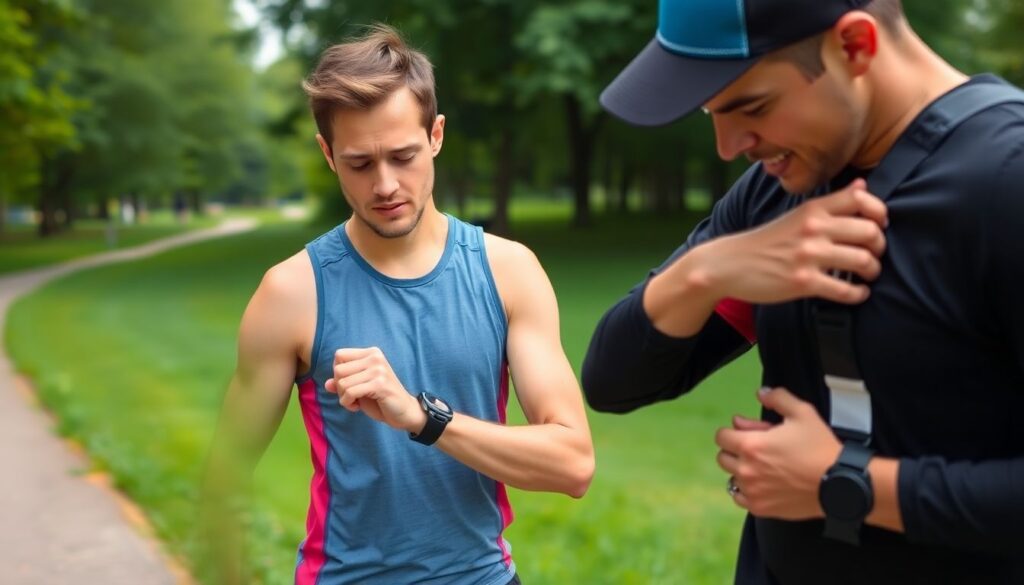
Continuous HR indicates internal load during sessions and intensity zones across sports. Wrist-based HR is usually fine for steady-state runs and functional training; chest straps are better for short, intense intervals and team sports. Practical tip: use HR to ensure easy days stay easy, not to turn every run into a race. - Heart Rate Variability (HRV)
HRV reflects autonomic nervous system balance and is a sensitive marker of recovery and cumulative stress. Ideally measured daily, in the morning, with the same device and posture. Focus on multi-day trends versus your baseline, adjusting training when HRV is consistently suppressed. - Blood Oxygen Saturation (SpO2)
Wearables estimate SpO2 via red/infrared light through the skin. It is useful mainly for altitude training monitoring, potential breathing issues, or high-load travel phases. Because sensor noise is common, prioritize significant and repeated drops, not single low readings. - Respiration Rate
Respiration is derived from PPG signal changes or accelerometers on the chest. At rest, changes over time can indicate illness, overreaching, or high stress. During training, breathing rate combined with HR helps classify intensity domains and ventilatory thresholds. - Skin or Body Temperature
Temperature tracking helps detect early signs of infection, menstrual cycle phases, and heat load. Ear or core-like sensors are more accurate; wrist or ring estimates are trend-focused. For outdoor athletes in Brazil, monitoring night-time temperature trends supports heat acclimation strategies and training-time choices. - Sleep and Recovery Indices
Though not a single metric, wearables para monitorar sono e recuperação de atletas combine HR, movements, and temperature to provide sleep staging, time in bed, and composite "recovery scores". Use them to nudge bedtime consistency and to flag periods where extra rest or reduced volume is wise.
Mechanical and workload measures: GPS, accelerometry, power and load
Mechanical and external workload metrics show how much work the athlete actually performed, complementing internal load signals like HR or RPE. Together, they form the basis of modern dispositivos smart para avaliação de performance esportiva, especially when training structure and competition demands are analyzed side by side.
- Outdoor running and cycling with GPS
Scenario: a road runner uses a relógio inteligente esportivo para monitorar desempenho and track pace, distance, and elevation across weeks. GPS data helps compare key sessions on the same route, evaluate progress toward race pace, and control overpacing during long runs. - Change-of-direction and team sports with accelerometry
In football, futsal, or basketball, GPS alone misses many accelerations, decelerations, and jumps. Inertial sensors in vests or bands capture high-intensity efforts, player load, and jump counts. Coaches in clubs can plan weekly high-speed running exposure and jump volumes to reduce soft-tissue injury risk. - Cycling power meters and running power
Scenario: a triathlete pairs a bike power meter with a smartwatch to keep specific wattage for intervals, regardless of wind or slope. Power reflects work in real time, allowing accurate pacing and post-session analysis of intensity distribution and training stress. - Strength and functional training
In the gym, wearables plus bar or body accelerometers estimate velocity, jump height, and repetition count. With the melhor smartwatch para corrida e treino funcional, athletes can track circuit density (reps per minute), ensuring adequate rest, and monitor how barbell velocity changes under fatigue. - Micro-loads for return-to-play
When returning from injury, precise workload tracking (distance, impacts, changes of direction, power) helps medical staff and coaches progressively reintroduce game-like demands. Session-by-session comparisons with pre-injury benchmarks make decisions more transparent to athletes and staff.
Protocols for reliable data collection: calibration, sampling and contextual tagging
Consistent protocols are what convert wearables from "cool gadgets" into decision tools. Calibration, sampling frequency, and contextual notes ensure that the numbers from a pulseira fitness profissional para saúde e performance are comparable across days, athletes, and environments.
Advantages of structured data protocols
- Improved data quality and fewer artefacts, especially for HR, HRV, and GPS tracks.
- Easier comparison across sessions, weeks, and athletes within the same team.
- Faster detection of meaningful changes from baseline (fitness or fatigue).
- Better communication with coaches: clear, standard reports based on stable metrics.
Limitations and practical constraints
- Perfect lab-like conditions are unrealistic on the field; movement, sweat, and contact will create noise.
- Athletes may forget to start/stop activities, wear the device correctly, or charge batteries.
- Overly complex tagging systems reduce adherence; simple categories are more sustainable.
- Sensors and firmware change over time, complicating long-term comparisons unless managed carefully.
Simple protocol example: for daily HRV, athletes measure each morning after waking, lying down, for 60-120 seconds, with the same app and device. For sessions, they always record: type (e.g., tempo run, strength upper body), RPE (0-10), and any unusual context (heat wave, poor sleep, travel).
Interpreting trends: baseline, variability, thresholds and individualization
Interpretation is where many athletes and coaches struggle. Wearables are often marketed with universal scores and color codes, but effective use requires understanding typical variability, personal baselines, and context. Misinterpretations can lead to unnecessary fear, data obsession, or, conversely, ignoring valuable signals.
- Myth: "More data always means better decisions"
Reality: too many unprioritized numbers cause confusion. Choose a small dashboard: for example, sleep duration, HRV trend, and weekly load. Add new metrics only if they change a specific decision. - Myth: "One bad night or low HRV means you must cancel training"
Reality: individual readings are noisy. Look for 2-3 days of consistent change plus subjective fatigue and performance signals before adjusting the plan more aggressively. - Myth: "The same thresholds apply to all athletes"
Reality: a given HRV value or resting HR can be normal for one athlete and abnormal for another. Build personal baselines over several weeks, then watch relative deviations instead of chasing population norms. - Myth: "Wearable sleep stages are exact"
Reality: most consumer devices estimate, not directly measure, stages. Use sleep tracking mainly to improve regularity, total duration, and pre-sleep routine-not to stress over exact minutes in each stage. - Myth: "A high "readiness" score guarantees great performance"
Reality: scores are helpful guides but do not capture tactics, psychology, or competition context. Use them to adjust volume and intensity, not as an excuse for poor effort or as a guarantee of victory.
Integrating data into training and recovery plans: actionable decision rules
To make wearables truly useful, convert metrics into simple rules and mini-scenarios that guide day-to-day decisions. The goal is not to replace coaching intuition, but to provide objective guardrails-especially across long seasons, travel, and multi-competition weeks common for Brazilian athletes.
Example decision rules for a semi-professional runner:
- Morning check: if HRV is within normal range and sleep > ~7 hours, follow the plan. If HRV is slightly low but the athlete feels good, keep the session but reduce volume by 10-20%.
- Serious red flag: if HRV is clearly depressed for 2-3 consecutive days, resting HR is higher than usual, and RPE for easy runs is elevated, downgrade hard sessions to easy aerobic runs or cross-training until metrics normalize.
- Weekly load overview: compare GPS distance and time in high-intensity zones week-to-week. Avoid abrupt spikes that exceed your typical progression; instead, adjust sessions earlier in the week when you see that load is creeping too high.
- Recovery planning: after travel or heat exposure, prioritize sleep extension (going to bed 30-45 minutes earlier) and lighter sessions when your wearable flags reduced sleep efficiency or higher night-time temperature.
Mini-scenarios by sport:
- 5 km road runner: uses HR and pace from a relógio inteligente esportivo para monitorar desempenho to keep most weekly mileage in low intensity; long runs are extended only when sleep and HRV stay stable.
- CrossFit / functional training athlete: with the melhor smartwatch para corrida e treino funcional, monitors session HR, post-session HRV, and subjective soreness to alternate heavy, moderate, and skill-focused days.
- Professional footballer: combines club GPS/accelerometry data and home wearable sleep metrics to negotiate small changes in training load after long flights or congested match schedules.
Final checklist for practitioners and athletes
- Define 3-5 key metrics you will track (e.g., HRV, sleep duration, weekly load, RPE).
- Standardize measurement routines (time of day, device placement, tagging of sessions).
- Build at least a few weeks of baseline data before making strong conclusions.
- Translate metrics into 3-5 clear decision rules for adjusting training and recovery.
- Review trends monthly with coach or staff and refine which wearables and metrics are truly helping.
Practical Clarifications and Common Implementation Issues
How accurate are wrist-based heart rate sensors for high-intensity training?
Wrist-based HR is generally acceptable for steady-state efforts but can lose accuracy during sprints, rapid changes of pace, or when the strap is loose. For high-intensity intervals or team sports, pairing your watch with a chest strap is recommended.
Do I need different devices for training and for sleep tracking?
Many modern wearables handle both reasonably well. However, if your training device is heavy or uncomfortable at night, consider a lighter ring or band for sleep and HRV, and sync data into the same platform whenever possible.
How long should I collect data before changing my training plan?
Collect at least several weeks of consistent data to establish a baseline. You can make minor adjustments earlier, but major changes should be based on stable trends rather than the first few days of measurements.
Can I rely on wearable sleep stages to diagnose sleep problems?
No. Consumer wearables are not medical devices and cannot diagnose sleep disorders. Use them to monitor duration, timing, and consistency, and consult a sleep specialist if you suspect a clinical issue.
What if my wearable, app, and coach all use different "training load" metrics?
Choose one primary system to avoid confusion, and translate its load categories into language your coach uses. Focus on relative changes and patterns rather than trying to reconcile every proprietary score.
Are wearables useful for athletes who train only three times per week?

Yes, but priorities differ. Emphasize sleep, daily HRV, and step counts or light activity on non-training days, using the device mainly to build healthy routines and avoid large gaps between sessions.
How should teams manage data privacy when using wearables with players?
Clarify who owns the data, who can access it, and for what purposes, ideally in written agreements. Share only information needed for performance and health decisions, and respect athletes’ rights and local regulations.