Wearable devices improve performance and help prevent injuries when you use them to control load, recovery, and technique instead of chasing random numbers. Start with one or two core metrics, define safe ranges, adjust training gradually, and regularly compare wearable data with how your body feels and how you actually perform.
Essential insights on wearables for performance and injury prevention
- Wearables are most useful when linked to clear goals: pace, strength, recovery, or injury reduction.
- For runners in Brazil, a relógio esportivo com gps e monitor cardíaco often covers 80% of daily needs.
- Sleep and recovery tracking are as important as distance and speed for long-term progress.
- Use heart rate, RPE (effort), and movement data together; never rely on a single number.
- Progressive load changes guided by wearables are safer than sudden increases in volume or intensity.
- Data are only helpful if they change decisions about training, rest, or technique.
How wearable sensors track biomechanics and workload
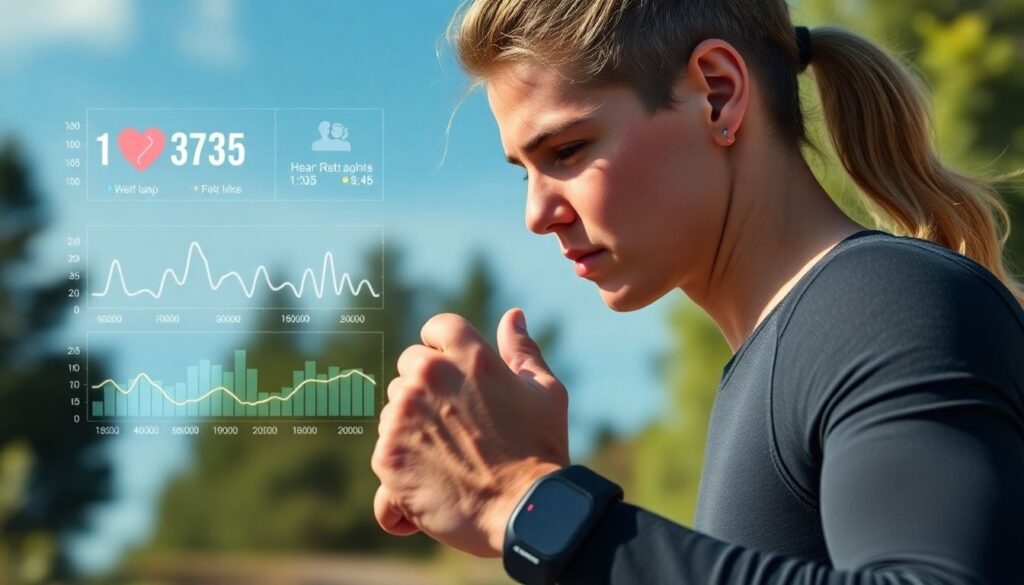
Wearable sensors collect continuous physiological and mechanical data from the body while you move. They estimate workload, efficiency, and fatigue using built-in accelerometers, gyroscopes, GPS, and optical heart rate sensors.
These tools are best suited for:
- Intermediate runners, cyclists, and gym-goers who already train regularly and want structured progress.
- Coaches and personal trainers who need objective metrics to plan and monitor sessions.
- Athletes returning from injury, where load control and gradual progression are critical.
Situations where you should not rely primarily on wearables:
- Acute pain, strong dizziness, chest pain, or shortness of breath: stop and seek medical care; do not trust the watch to clear you.
- Serious cardiac, respiratory, or metabolic conditions without medical supervision.
- Early rehabilitation phases where a physiotherapist prescribes very specific protected movements.
Core ways wearables track biomechanics and workload:
- External load: distance, pace, speed, elevation, reps, sets, bar path, and jump count (via GPS and motion sensors).
- Internal load: heart rate, heart rate variability, estimated VO₂max, and perceived exertion markers.
- Movement quality: cadence, ground contact time, balance left/right, impact forces (depending on device).
- Recovery state: sleep duration, sleep stages, resting heart rate, readiness and recovery indexes.
Selecting devices for training goals: metrics that matter
Before choosing hardware, define what you want to control and how often you can look at data. In the pt_BR context, availability, price, and app language support also matter for adherence.
Minimum requirements by training goal
- Running-focused users: Need reliable GPS, continuous heart-rate, lap/interval control, and simple pace zones.
- Strength and functional training: Need rep counting, set timers, and at least heart-rate zones to monitor intensity.
- Recovery and health: Need solid sleep tracking and resting HR/HRV trends, ideally via a comfortable bracelet form factor.
- High-performance athletes: Need accurate heart-rate, advanced metrics (ground contact, cadence), and exportable data for analysis.
Comparison of main wearable types
| Device type | Best use | Key strengths | Limitations | When to choose |
|---|---|---|---|---|
| GPS sports watch | Outdoor running, cycling | Accurate distance and pace, robust battery, sport profiles | Limited sleep detail on some models | When you want a relógio esportivo com gps e monitor cardíaco primarily for endurance training |
| General-purpose smartwatch | Mixed use: office, corrida, academia | Smart notifications, apps, sufficient sports metrics | Battery life often shorter, some metrics less precise | When you want the melhor smartwatch para corrida e academia and also daily use features |
| Fitness bracelet | Daily activity, sleep, light workouts | Comfortable, discreet, affordable, good sleep tracking | Fewer advanced sport metrics, small screen | When you prefer a bracelete fitness para monitorar sono e recuperação muscular, not heavy analytics |
| Chest-strap HR monitor | Intervals, HIIT, lab-like sessions | Very accurate heart-rate for quick intensity changes | Less comfortable, only HR (needs watch/phone) | When you need a monitor de frequência cardíaca para treino de alta performance |
| Dedicated motion sensors / pods | Technique, biomechanics analysis | Advanced running form and jump metrics | Requires more setup and interpretation | When you or your coach focus on dispositivos wearables para prevenção de lesões esportivas via technique |
Practical selection checklist
- Confirm that the app supports Portuguese (Brazil) and integrates with your current training platform.
- Prioritize comfort: if it is not comfortable on your wrist or chest, you will stop using it.
- Check battery for at least one full week of normal use or several training sessions without recharge.
- Look for easy-to-read training screens with pace, HR zone, and time at a glance.
- Avoid overpaying for exotic metrics you do not plan to use in the next six months.
Integrating wearables into periodized training plans
Use wearables to connect your macrocycle (months), mesocycle (weeks), and microcycle (sessions). The goal is not perfect data, but consistent decisions that protect health and drive performance.
- Define the main objective for the next 8-12 weeks.
Decide whether you prioritize finishing a race, improving time, gaining strength, or staying injury-free during a busy period. This determines which wearable metrics become central (eg, weekly distance vs. total sets vs. sleep trends). - Choose 2-3 primary metrics per objective.
Too many numbers create noise. For most intermediate users:- Running: weekly distance, intensity distribution (time in HR zones), pace at easy effort.
- Strength: total weekly sets per muscle group, average session HR or RPE, session duration.
- Recovery: sleep duration, resting heart rate, weekly step count or low-intensity minutes.
- Establish safe starting baselines.
Take 1-2 weeks to observe your usual metrics without trying to improve. Use this as your starting load. If you already train, avoid increasing weekly load more than a small, gradual amount from this average. - Map wearables to your training phases.
For each mesocycle (build, peak, deload), write how metrics should evolve:- Build: slight increase in weekly distance or volume, controlled HR, stable sleep.
- Peak: stable or slightly higher intensity, similar distance, very close attention to fatigue signs.
- Deload: reduced distance/volume and lower HR at the same pace, more sleep and recovery.
- Set simple daily decision rules.
Translate data into actions you can execute quickly:- If resting HR is clearly higher than your usual and you feel heavy, reduce session volume.
- If sleep is poor for several nights, shift high-intensity work to later in the week.
- If an easy run shows unusually high HR, change to recovery pace or shorten duration.
- Review and adjust weekly.
Once per week, check trends instead of isolated numbers. Decide whether to maintain, slightly increase, or slightly reduce load for the next week. Document changes so future cycles are easier to plan and safer.
Fast-track mode: minimal algorithm for busy users
- Pick one goal for 8-12 weeks (eg, 5K time, strength PR, or pain-free training).
- Track 2 metrics only: weekly volume and sleep duration.
- Increase weekly volume slightly when sleep and energy are stable.
- Maintain or lower volume when sleep worsens or resting HR is clearly above normal.
- Repeat this pattern; do not make two big changes (volume and intensity) in the same week.
Micro case: 10K runner with knee pain history
A Brazilian amateur runner with previous knee pain wants to run a 10K faster.
- Objective: finish 10K without pain and slightly faster than last time.
- Metrics: weekly distance, time in moderate HR zone, sleep duration.
- Plan: 4 runs/week, distance increased slowly, with one lighter week each month. If knee discomfort appears and HR is higher than usual at easy pace, the runner reduces distance and adds an extra rest or cross-training day.
Interpreting data: actionable thresholds and red flags
Use this checklist weekly to keep training both effective and safe.
- Is your resting heart rate staying close to your usual, or clearly trending up together with fatigue and irritability? If up, consider reducing load or improving sleep.
- Does your pace at easy HR become slower for several sessions in a row? This may indicate accumulating fatigue or early illness, not just a bad day.
- Is your weekly distance or total sets per muscle group jumping more than you can adapt to smoothly? Sudden spikes in load are linked to higher injury risk.
- Are high-intensity sessions increasing in both number and duration in the same week? Limit changes to one dimension at a time (more sessions OR longer sessions).
- Is sleep duration and quality stable or improving while you increase training? If both decline while load rises, you are likely pushing too hard.
- Do you see repeated asymmetries (eg, ground contact time or power left/right) plus local discomfort? This combination justifies checking technique and possibly consulting a professional.
- Are you frequently unable to stay within your planned HR zone even at lower speeds? This suggests poor recovery or unrealistic pace targets.
- Do your best sessions still feel good mentally, or are they all a struggle despite decent numbers? Perceived fatigue is as important as the data.
Protocols for using wearables to reduce injury risk
Common mistakes to avoid when using dispositivos wearables para prevenção de lesões esportivas.
- Chasing daily records (steps, distance, calories) without any rest days, leading to chronic overload.
- Increasing weekly distance or training volume aggressively because the watch suggests a more ambitious target.
- Ignoring pain or persistent discomfort because metrics like HR or pace look normal on the screen.
- Comparing your data to friends or influencers instead of respecting your own adaptation speed.
- Switching between many different apps and devices, making it hard to see consistent long-term trends.
- Using advanced metrics (VO₂max, training load score) as exact truth instead of approximate guides.
- Training in only one HR zone because the watch labels it as “fat burn” or “cardio”, instead of working across a range of intensities over the month.
- Wearing the device too loose or in the wrong position, which produces noisy data and misleading conclusions.
- Skipping warm-up and cool-down because the numbers do not “count” as much as the main part of the workout.
Validating device data and maintaining measurement consistency
You do not need lab-level precision, but you do need repeatable, believable trends. Use these approaches when you want confirmation or alternatives.
Consistency-focused approach
- Wear your device in the same position and tightness for each session, especially for optical HR sensors.
- Use the same measurement conditions for comparison (eg, resting HR measured in the morning before coffee, not at random times).
- Avoid changing multiple things at once (device, training time, environment), which makes trends harder to interpret.
Troubleshooting checklist for suspicious data
- Is the strap too loose, dirty, or placed over tattoos or very hairy skin that interfere with optical sensors?
- Did you recently update firmware or switch apps, which might change algorithms or display units?
- Are you training in environments with poor GPS signal (tunnels, dense buildings, heavy tree cover)?
- Do multiple sessions show unrealistic spikes or drops, or only a single workout? One “weird” file is usually just noise.
- Have you cross-checked with perceived effort or another device (eg, manual pulse count, gym equipment display) to see which source aligns better?
Alternative and complementary solutions
- Manual logs plus simple devices: Use a basic watch or timer, manual RPE scores, and a paper or digital log. This suits athletes who dislike technology but still want structure.
- Gym or lab assessments: Periodic evaluations (lactate, VO₂, strength tests) provide precise snapshots that you can link to wearable trends.
- Coach or physiotherapist oversight: Share your wearable data with a professional who can align training load, pain levels, and technical feedback.
- App-only tracking: For very budget-conscious users, phone-based GPS and manual HR input can still support basic planning and load control.
Practical answers to common implementation challenges
How do I start if my wearable shows too many metrics?
Select no more than three: one for load (distance or sets), one for intensity (HR or pace), and one for recovery (sleep or resting HR). Hide the rest from your main training screens and summaries for now.
What should I do when heart-rate and perceived effort do not match?
First, check for technical issues (strap position, battery, firmware). If the reading seems technically correct, trust perceived effort in the short term and look for patterns across several sessions instead of reacting to a single mismatch.
How often should I change training based on wearable data?
Use data to make small day-to-day adjustments and more structured changes weekly. Avoid rebuilding your entire plan after one bad night of sleep or a single difficult session.
Can I rely on wearables to come back from an injury faster?
You can use them to avoid doing too much too soon by tracking load and recovery. They do not replace medical or physiotherapy guidance, but they help you respect progression and flag abnormal fatigue or asymmetry.
Are cheap devices good enough for serious training?
For many intermediate athletes, yes, if you prioritize consistency over extra features. Check that GPS, heart-rate, and sleep tracking are reasonably stable and that the app lets you see weekly trends and export basic data.
How long should I keep a training cycle before reviewing data deeply?
Most users benefit from a deeper review every 4-6 weeks. This is enough time for trends to appear and short enough to correct direction before fatigue or plateaus become a problem.
What if I feel anxious or obsessed with the numbers?
Limit screen checks during workouts, disable some notifications, and plan “data-light” days when you train more by feel. If anxiety persists, refocus on qualitative goals and consider reducing the number of tracked metrics.