
E-sports vs. traditional sports in 2026: same “athlete”, different battlefield
In 2026, the line between a football player and a League of Legends jungler is much thinner than most people think. Both chase performance under pressure, both live with injuries, and both depend on science-driven training.
The difference is where and how the body is stressed.
Traditional sports overload joints, tendons and the cardiovascular system.
E-sports overload vision, neck and upper back, wrists, sleep, and—above all—the nervous system.
So preparation, training routine and recovery are no longer “gym vs. chair”.
They’re two different engineering projects for the same machine: the human body.
—
Physical demands: what actually happens in the body
Traditional sports: macro stress

A 90‑minute football match can put peak loads of 5–7x bodyweight on knees and ankles in sprints and jumps. Heart rate often stays between 70–90% HRmax for long stretches. Injuries are usually “macro”: ligament tears, muscle strains, cartilage wear.
Typical adaptations coaches chase:
– Higher VO₂max and lactate threshold
– Stronger tendons and ligaments
– Power production (sprint, jump, change of direction)
And the training reflects that: pitch sessions, gym, conditioning, recovery blocks.
E-sports: micro stress and neuro stress
Pro e-sports in 2026 are a different beast. Top CS2, Valorant or LoL players routinely sustain:
– 300–600 actions per minute (clicks + keypresses) in peak fights
– Reaction times of 150–220 ms that must stay stable for 6–10 hours of daily practice
– Visual focus at 50–70 cm for thousands of hours per year
The result is a very particular mix of overload:
– Cervical spine and upper back from static posture
– Wrists and fingers from repetitive strain
– Eyes and visual cortex from constant near-focus and light exposure
– Autonomic nervous system from chronic stress and lack of sleep
That’s why any serious treinamento físico para jogadores de e-sports now starts with three pillars:
– Posture and spine
– Hand/wrist durability
– Nervous system resilience (sleep, stress, recovery)
—
Preparation: from “I just play” to structured performance
What “pre-season” means for a football team
Classic traditional-sport preparation looks like this:
– 4–6 weeks of pre-season
– Gradual increase of running volume and intensity
– Strength and power phases in the gym
– Tactical and technical integration
Here the goal is to “armor” the body for impacts and high-intensity running, build aerobic base, and rehearse game models.
What “pre-season” means for a pro e-sports team in 2026
Modern e-sports organizations now copy the structure, but not the content.
A typical 3–4 week block before a big split or major looks like:
– Week 1 – Medical screening + baseline:
– Posture and mobility assessment
– Grip strength, reaction time, simple cognitive tests
– Sleep and HRV baseline (Oura, Whoop, Garmin, etc.)
– Week 2–3 – Building the “hardware”:
– 20–30 minutes of targeted strength and mobility 3–4x/week
– Aerobic work 2–3x/week (low intensity, 20–30 minutes)
– Standardized warm-up before every scrim block
– Week 4 – Integration:
– Full scrim days, but with mandatory warm-up and cool‑down
– Team routines for sleep, caffeine, and blue-light management
The goal is not to turn the player into a runner. It’s to make sure he can sit, click and think at high level every day, without pain stealing attention.
—
Gym: why a gamer doesn’t need a marathon engine
Traditional sports: performance through overload
In football, basketball, or athletics, gym work focuses on:
– Heavy compound lifts (squat, deadlift, bench)
– Plyometrics (jumps, bounds, sprints)
– Specific conditioning (intervals, small-sided games, etc.)
Players often train 2x/day in pre-season and 5–8 on-field sessions per week. Load is high because the sport’s demands are high-impact and explosive.
E-sports: minimum effective dose
With gamers, physical training is like precise microdosing: enough to protect, but not enough to create fatigue that hurts performance at the PC.
Coaches working with tier-1 teams in 2024–2026 often center gym work on:
– 3 sessions/week, 25–35 minutes
– RPE (perceived effort) around 6–7/10 (moderately hard, not brutal)
– Focus on:
– Upper back, glutes and core (posture)
– Forearms and grip (mouse and keyboard durability)
– Light cardio for brain perfusion and metabolic health
A basic block for a pro could look like:
– 2 lower‑body + posture–focused days
– 1 upper-body + shoulders + scapula control day
– Plus 10 minutes daily of mobility for neck, hips, wrists
For aspiring pros, this is often structured via an online curso de preparação física para esportes eletrônicos, with video demonstrations and periodized plans.
—
Routine: how a day looks different
Day in the life of a traditional athlete
A typical day for a pro footballer in-season:
– Morning: team training (75–90 minutes on field)
– After: gym or injury-prevention block (20–40 minutes)
– Afternoon: meetings, tactical video, rest
– Evening: short walk, mobility, family time
Between matches there is a clear cycle: heavy days, light days, match day, recovery day.
Day in the life of a tier‑1 e-sports pro in 2026
In 2026, the top organizations have finally abandoned the “play 12 hours non‑stop” model. A common structure:
– 10:00 – Wake, light mobility, breakfast
– 11:00 – Team warm-up (10–15 minutes: breathing, mobility, activation)
– 11:15–13:30 – First scrim block
– 13:30–15:00 – Lunch + break (walk, nap, optional gym)
– 15:00–18:00 – Second scrim block
– 18:00–19:00 – Review + mental coaching
– 20:00–22:00 – Optional solo queue or VOD reviews
Now imagine overlaying that with a planilha de treino e dieta para atletas de e-sports:
– Protein target: 1.6–2.0 g/kg/day
– Caffeine cap: 3 mg/kg before 17:00, none at night
– Hydration reminders between scrims
– Carbs clustered before and between blocks to sustain focus
That spreadsheet usually comes from a performance department or external assessoria esportiva para pro players de e-sports, which coordinates physical coach, nutritionist and psychologist.
—
Recovery: ice bath vs. sleep hygiene
Traditional sports: muscles and joints first
For traditional sports, recovery protocols revolve around:
– Cold water immersion
– Active recovery runs or bike
– Soft tissue work (massage, foam rolling)
– Compression, contrast showers, sometimes cryotherapy
These methods target inflammation, soreness and neuromuscular fatigue from high mechanical load.
E-sports: brain and nervous system first
In e-sports, mechanical load is low; nervous and cognitive load is enormous. So the modern programa de recuperação e fisioterapia para gamers profissionais focuses on:
– Sleep:
– 7.5–9 hours, consistent bed/wake times
– Limiting blue light or using filters in the last 60–90 minutes
– Cooling the bedroom to ~18–20 °C
– Micro‑breaks:
– 5 minutes every 50–60 minutes away from the screen
– Eye exercises: 20–20–20 rule (every 20 minutes, look 20 feet away for 20 seconds)
– Active “unplugging”:
– Short walks after scrims
– Low‑intensity cardio 2–3x/week (20–30 minutes)
– Breathing exercises to downshift the nervous system
– Targeted physio:
– Manual therapy for neck/shoulders and forearms
– Mobility and strengthening for wrist, elbow, scapula
– Periodic screening for early carpal tunnel or tendinopathies
In football a heavy gym day can be “fatigue”; in e-sports a heavy night of ranked queues can be just as destructive for neural freshness the next day.
—
Injury profiles: what breaks and why
Football vs. e-sports: different failure points
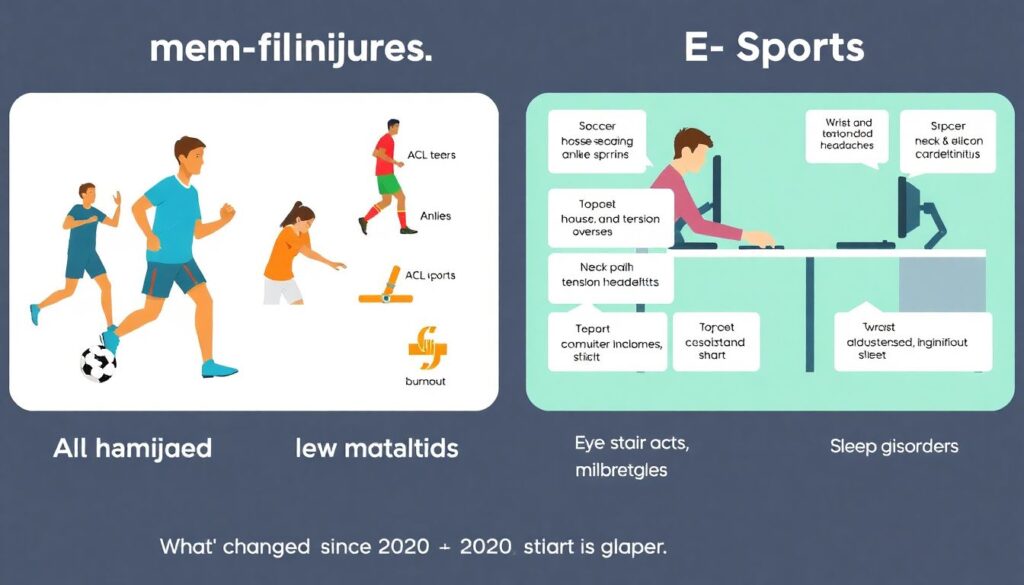
Traditional sports:
– ACL tears
– Hamstring strains
– Ankle sprains
– Chronic knee and hip issues
E-sports:
– Neck pain and tension headaches
– Wrist and elbow overuse (tendinitis, carpal tunnel syndrome)
– Eye strain and migraines
– Sleep disorders, anxiety, burnout
What’s changed since 2020 is that by 2026, teams and agents know that a 20‑year‑old prodigy can lose his career not just to a torn ligament, but to burnout and chronic pain that make him unable to grind.
That’s why physio for teams like in LEC, LCK or VCT now starts before pain appears, just like prehab in traditional sports.
—
Modern trends in 2026: where both worlds are converging
1. Data and wearables
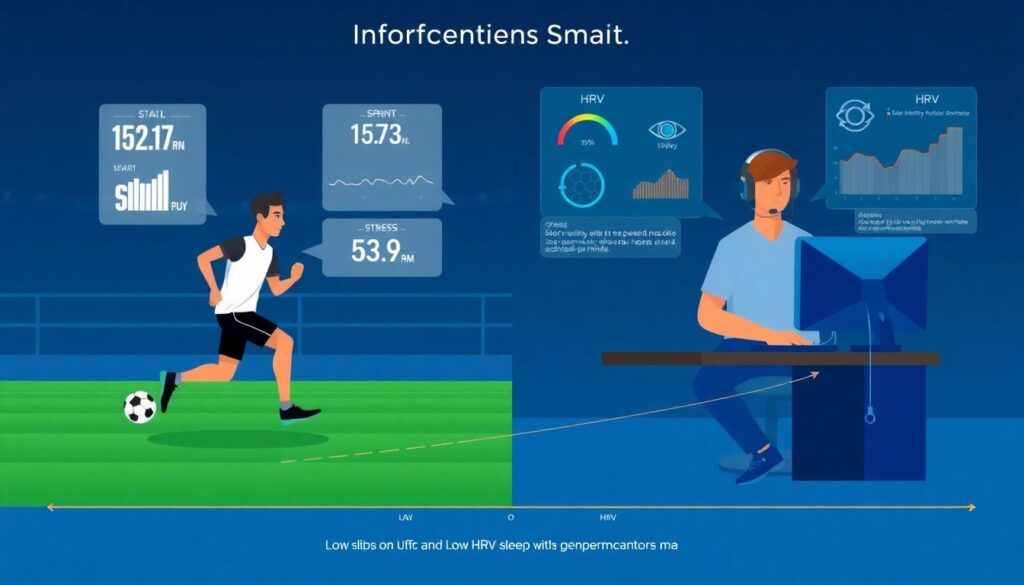
Traditional sports embraced GPS and HR monitors over a decade ago. Now:
– Football: tracking distance, sprint count, accelerations, HR, HRV
– E-sports: tracking sleep, HRV, stress, and sometimes eye-tracking and click metrics
Teams correlate days of low HRV and poor sleep with drops in performance: slower reaction times, more misclicks, worse aim stability. That feeds back into adjusting training volume and scrim intensity.
2. Integrated performance teams
The old model: one coach, maybe a manager.
The 2026 model in high-level orgs:
– Head coach
– Strategic coach / analyst
– Physical coach
– Nutritionist
– Psychologist or performance coach
– Physiotherapist
The structure is now surprisingly similar in football clubs and tier-1 e-sports, only the content of each professional’s work changes.
3. Mental health as performance variable
In both worlds, but especially in e-sports, mental health in 2026 is treated like sleep: a measurable part of performance. Common tools:
– Regular 1:1 sessions with sports psychologists
– Group sessions on communication and tilt management
– Cognitive training (working memory, focus switching)
Traditional sports always had pressure, but e-sports adds:
– Social media toxicity
– Public scrim leaks, constant stream sniping accusations
– Early specialization (kids grinding rank since 12–13 years old)
Managing this became as important as managing training load.
—
How a gamer should (not) copy a football player
What to borrow
From traditional sports, gamers can safely copy:
– Structured warm-up and cool-down routines
– Strength and mobility work 2–3x/week
– Regular screening and physio “prehab”
– Periodization: heavier and lighter days, instead of blind grind
What to avoid
What doesn’t translate well:
– High-volume running or HIIT every day
– Constant near-max strength work (1–3RM)
– Random bodybuilding splits with no connection to the demands of the game
To put it plainly: a pro aimer doesn’t need a 180 kg squat. He needs:
– No pain sitting 6–8 hours
– Stable hands and shoulders
– Clean, repeatable posture
– Full cognitive speed in every map of a BO5
Anything that damages those points—even if it’s “healthy” in general fitness terms—is counterproductive.
—
Practical checklist for 2026 pro (or aspiring pro) gamers
If you’re trying to behave like a modern athlete, not just “a guy who plays a lot”, you need at least:
– Physical plan
– 2–3 gym or bodyweight sessions/week (20–40 minutes)
– Daily micro-mobility for neck, wrists, hips
– At least 2x/week light cardio
– Nutrition and lifestyle
– Protein in every main meal
– Regular eating times around scrims, not just snacking
– Caffeine planned, not constant
– 7.5–9 hours of sleep in a dark, cool room
– Recovery and monitoring
– Sleep and HRV tracking if possible
– Weekly check-in: pain scale for neck, wrists, back, eyes
– At least one complete unplugged day every 2–3 weeks during long splits
If your budget allows, an external assessoria esportiva para pro players de e-sports can help build and adjust that plan over the season, the same way distance coaching works for runners or cyclists.
—
Conclusion: same rules of biology, new applications
E-sports and traditional sports don’t contradict each other; they illustrate the same biological rules under different stress patterns.
– Traditional sports: impact, running, collisions, muscle damage.
– E-sports: sitting, micro-movements, visual overload, constant cognitive pressure.
In both, those who last more than a couple of seasons in 2026 are the ones who:
– Respect recovery as much as training
– Treat physical preparation as part of their skill set
– Use data to adjust, instead of grinding blindly
As the scene matures, the biggest competitive edge is no longer just a new strategy or a crazy aim routine.
It’s turning the “person behind the keyboard” into a complete athlete—physically, mentally and physiologically optimized for the digital arena.