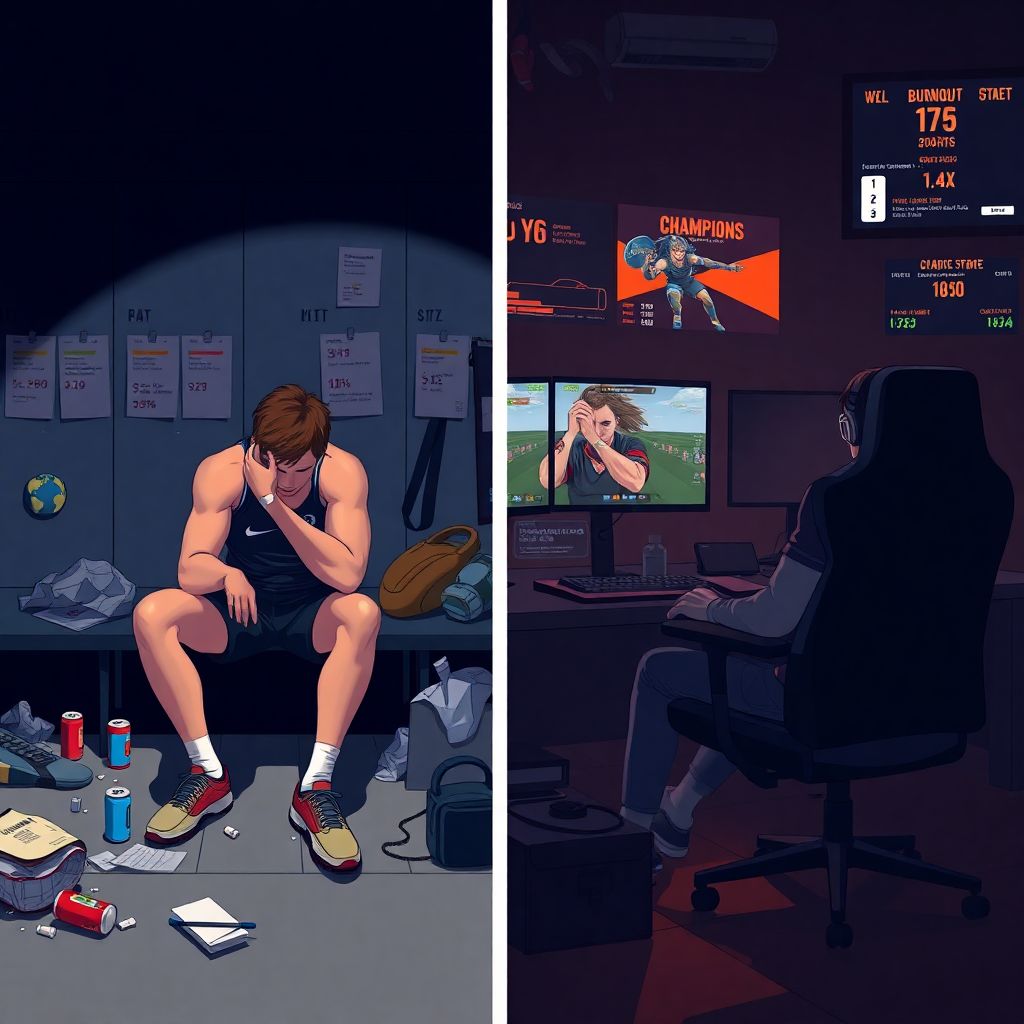
Why mental health in sport and E‑Sports can’t be “optional” anymore
In 2026, high‑level sport and E‑Sports look glamorous from the outside, but inside they often feel like a pressure cooker. Long training blocks, constant comparison on social media and unstable careers create a perfect storm for anxiety, depression and burnout. Even teenagers in amateur leagues already talk about sleep meds, energy drinks and “playing through pain”, both physical and emotional. The stigma is shrinking, but it’s still common to hear that “real champions don’t break”. That idea is outdated and dangerous: performance depends on the brain, and an exhausted brain makes slower decisions, tilts more, gets injured more and leaves promising careers cut short.
What burnout and pressure really look like in athletes
Burnout isn’t just “being tired of the game”. It’s a mix of emotional exhaustion, loss of meaning and cynicism toward training and competition. In traditional sports, it often appears as constant irritability with coaches, a body that never seems to recover and that quiet thought: “If I quit today, maybe I’d finally breathe.” In E‑Sports, burnout usually arrives with tilted scrims, autopilot play and compulsive grinding without intention. The athlete may still show up every day, but feels empty, disconnected from teammates and almost allergic to feedback, because any criticism sounds like proof of failure.
Warning signs in traditional competitive sports
In classic sports, early red flags are subtle: warm‑ups feel heavier, small mistakes trigger outsized guilt, and rest days start to seem like weakness instead of recovery. Sleep quality drops, or the athlete sleeps too much but never feels restored. Injuries become chronic or “mysteriously” frequent because the body is under constant stress. Social life shrinks around training and competition, leaving almost no space for identity beyond results. When saúde mental no esporte competitivo tratamento online began to spread after the pandemic, many athletes recognized themselves in checklists of burnout and realized that what they called “lack of willpower” was actually a treatable condition, not a character flaw.
Burnout and pressure in E‑Sports: different game, same brain
In E‑Sports, pressure is turbo‑charged by the internet. Scrims, ranked queues, streaming obligations and constant patches push players to stay online even when their minds are offline. Burnout can look like procrastinating practice, alt‑tabbing to social media between every match or chasing “one more game” deep into the night, only to hate every minute. Toxic chats and public criticism after losses hit especially hard because everything is archived and shared. A psicólogo do esporte para e-sports atendimento often hears stories of players who can’t separate game results from self‑worth, treating every bad KDA or misplay as proof that they’re failures as people, not just underperforming that day.
Necessary tools: what actually helps protect your mind
Tools for mental health don’t need to be fancy, but they must be deliberate. The basics are boring and powerful: consistent sleep routines, scheduled breaks, realistic training loads and nutrition that doesn’t rely on sugar plus caffeine. On top of that, athletes in 2026 benefit from mental skills training: breathing techniques for pre‑match nerves, visualization for confidence, and post‑performance reviews that focus on learning instead of blame. Digital hygiene matters too: turning off certain notifications, setting time limits for social media and separating competitive and casual accounts can dramatically lower emotional noise, especially after tough defeats or public mistakes.
Professional support: when and how to bring in experts
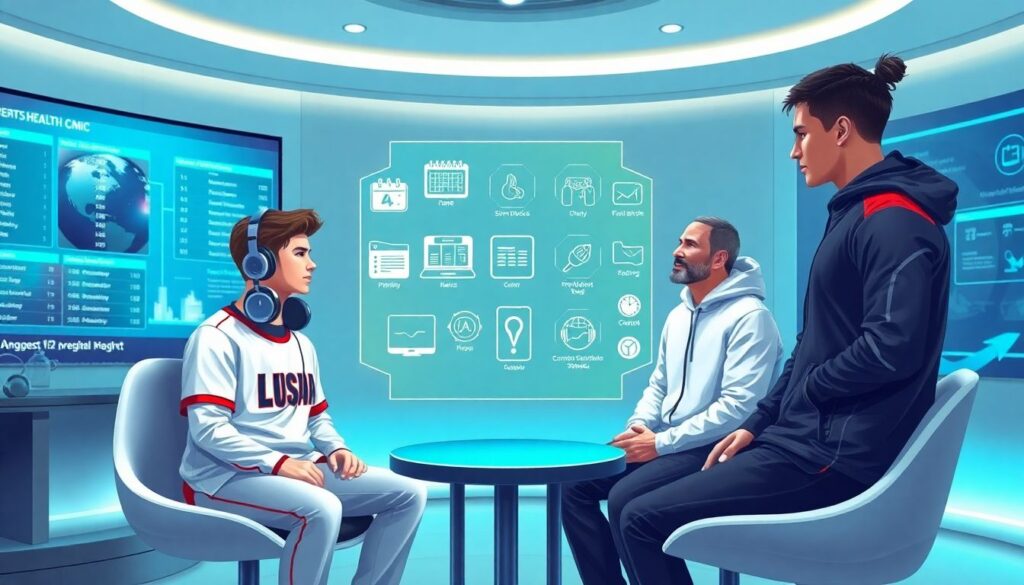
Self‑care has limits. At higher levels, involving professionals stops being a luxury and becomes risk management. A clínica de saúde mental especializada em esportes e e-sports understands travel schedules, scrim blocks and ranking systems, and won’t just say “play less” as a generic solution. Many offer saúde mental no esporte competitivo tratamento online, letting players talk from bootcamps or tournament hotels. For persistent exhaustion or loss of motivation, terapia para burnout em atletas de alta performance combines cognitive‑behavioral tools, adjustment of training loads and sometimes medical evaluation. Sports psychologists, psychiatrists and physical coaches collaborating as one team tend to catch problems earlier and prevent crises instead of waiting for breakdowns.
Step‑by‑step process for dealing with burnout and pressure
There’s no magic shortcut, but a structured approach helps. Think of it as a reset protocol, not a sign of defeat. The goal is to restore capacity, then redesign your routines so the same spiral doesn’t repeat every season. This roadmap works for both traditional athletes and E‑Sports pros, with small adaptations for your specific game or sport. If possible, walk through it with a coach or mental health professional, but you can start on your own today and seek extra support along the way if signs are more intense or long‑lasting.
Practical roadmap you can follow
1. Name the problem
Admit, at least to yourself, that something’s off. Write down symptoms: sleep, mood, motivation, performance swings, health issues. Seeing the pattern reduces confusion.
2. Reduce the overload
With your coach or manager, cut or adjust volume: fewer scrims, lighter gym sessions, shorter queues. You’re not quitting; you’re stabilizing the system.
3. Rebuild routines
Add fixed breaks, weekly off‑days and a realistic bedtime. Protect at least one hobby or social activity unrelated to sport or gaming.
4. Bring in professionals
Look for a psicólogo do esporte para e-sports atendimento or a physician if there are physical complaints. Online options are valid if local help is limited.
5. Review and adjust
Every two weeks, reassess: what’s better, what’s worse, what triggers remain? Update training, screen time and goals accordingly.
Troubleshooting: when the plan isn’t working
Sometimes you’ll follow all the steps and still feel stuck. That doesn’t mean you’re hopeless; it means the problem is deeper or has been going on longer than you realized. If symptoms last more than a month, or if you notice dark thoughts like “it would be easier if I disappeared”, you’ve crossed from normal pressure into a clinical zone. In that case, self‑help is not enough. Contact a clinician, tell a trusted teammate or family member and pause non‑essential competitions. Missing a tournament to protect your mind is painful now, but far cheaper than abandoning your career five years early because nothing feels bearable anymore.
Specific problems and how to respond
If you can’t sleep before matches, experiment with pre‑bed rituals: dim lights, stretching, no screens 30 minutes before lying down and a consistent wake‑up time. If tilt in E‑Sports is your main enemy, design a non‑negotiable tilt protocol: after two heavily emotional losses, mandatory five‑minute break away from the PC, plus a short breathing exercise or journaling of key mistakes without insults. For teams, programas de prevenção de burnout para equipes de e-sports should include rotation of players, flexible scrim loads and clear rules about feedback that attack plays, never personalities, keeping criticism informative, not cruel.
How teams and organizations can change the game
Individual strategies work better inside healthy systems. Teams that still romanticize 14‑hour practice days are quietly burning money in 2026. The most successful organizations treat players like long‑term investments, not disposable assets. They track training loads, use wellness check‑ins and give staff the power to adjust calendars based on fatigue data. Coaches are trained to spot not only tactical errors, but emotional red flags in body language and voice tone. Partnering with a clínica de saúde mental especializada em esportes e e-sports allows clubs to run assessments each season, customizing support instead of waiting for someone to crash mid‑split or right before playoffs.
The future of mental health in competitive sports and E‑Sports
Looking ahead from 2026 to the early 2030s, mental health support is likely to become as standard as physical conditioning. Biometric data from wearables and in‑game analytics will be combined to predict overload before players feel destroyed. AI‑assisted coaching will flag unhealthy training patterns and suggest breaks or schedule changes. Regulations might require minimum rest days in leagues, and young academies will probably include mental skills alongside mechanics from the start. Therapy for burnout in atletas de alta performance is already shifting from crisis response to continuous monitoring. The big shift will be cultural: fans, sponsors and organizations slowly understanding that a stable, supported brain doesn’t weaken competitiveness; it’s what makes long, legendary careers even possible.