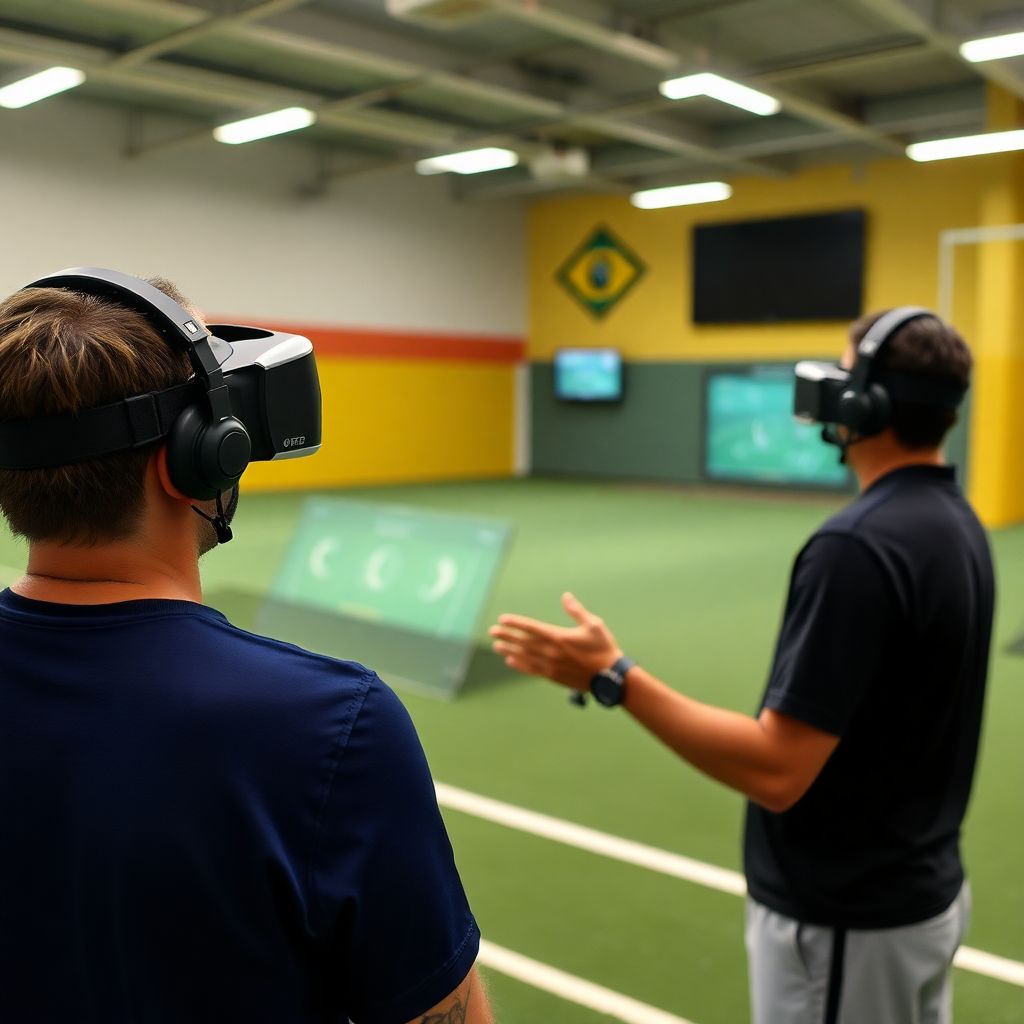
Virtual reality is changing sport training in Brazil by adding safe, repeatable, high‑intensity decision environments on demand. Coaches use it to rehearse tactical patterns, speed up reading of the game, and expose athletes to pressure without impact load. The key is structured scenarios, objective metrics, and tight integration with field practice.
Why VR improves both skills and tactics in sport
- Lets players repeat rare or high‑pressure situations (penalties, press breaks, fast breaks) many times with consistent tactical context.
- Separates decision‑making and perception from physical fatigue, so athletes can focus on reading the game first.
- Enables safe exposure to collisions, dangerous angles, and crowd pressure without real injury risk.
- Records head and gaze direction to coach scanning patterns, not only movement outcomes.
- Supports personalized tactical instruction, where each athlete sees their exact role in different systems and game models.
- Allows remote and off‑season sessions, useful when travel, weather, or injury limits normal training.
How current VR systems simulate sport-specific motor patterns
Most realidade virtual no treinamento esportivo today focuses on perception-action coupling: what the athlete sees, where they look, and how quickly they decide. Full‑body motion is usually simplified to head, hands and sometimes feet tracking, depending on the sport and budget.
Three common setups:
- Seated or standing, no locomotion – The athlete uses óculos de realidade virtual para atletas and simple controllers, focusing on scanning, anticipation and choices (e.g., where to pass under pressing).
- Room‑scale movement – The athlete can step, rotate, and perform partial sport actions in a small area, often combined with inertial sensors or simple wearables.
- Hybrid simulators – A simulador de realidade virtual para futebol may include a physical ball, kick platform, or directional treadmill to approximate kicking and sprinting mechanics.
This approach is suitable when you want to overload:
- Tactical understanding and pattern recognition.
- Perceptual skills: scanning, reading teammates and opponents, timing.
- Decision speed under time and information pressure.
It is not ideal when the main goal is:
- Maximal sprinting or change‑of‑direction mechanics (VR cannot yet match open‑field demands).
- Contact tolerance and grappling (wrestling, judo, rugby scrums) where physical feedback is crucial.
- Heavy technical refinement of fine motor skills where real ball, racket, or implement feel is decisive.
Evidence level: mostly expert consensus and pilot studies, with a growing number of controlled trials in football, basketball, and racket sports.
Designing VR drills for tactical pattern recognition and decision speed
To build effective treinamento tático com realidade virtual, you need a minimal but robust setup plus a clear workflow between staff and athletes.
Required hardware and space
- Stand‑alone or PC‑powered óculos de realidade virtual para atletas (commercial headsets are usually sufficient for clubs in Brazil).
- Comfortable, well‑ventilated room with safe boundaries, marked floor, and no obstacles.
- Optional: external trackers or wearables if you need finer body motion capture.
Software and content building
- Choose software de realidade virtual para preparação esportiva that matches your sport and allows:
- Importing game video or 3D reconstructions.
- Customizing scenarios (formations, opponents, score, time remaining).
- Exporting data (choices, reaction times, gaze paths if available).
- For football, a dedicated simulador de realidade virtual para futebol is useful to recreate pressing schemes, build‑up patterns, and set pieces.
Design rules for tactical VR drills
- Define the tactical problem clearly – Example: “Breaking a 4‑4‑2 high press on the right side” or “Defending the weak‑side cut in pick‑and‑roll”.
- Limit the number of options – Early drills should offer 2-3 realistic choices so athletes are challenged but not overwhelmed.
- Match the coach's game model – Positions, reference points, and cues must mirror live training language, not generic “video game” situations.
- Control difficulty – Increase opponent speed, reduce decision time, or add score/time pressure only after athletes perform consistently.
- Integrate feedback – Use short debriefs, video replays from the athlete's viewpoint, and questions like “What did you scan before deciding?”
Brief scenario examples
- Football (defensive midfielder) – Repeat 15 different build‑up patterns against various presses, focusing on body orientation, first touch direction, and scanning for third‑man runs.
- Basketball (wing) – Practice reading help defense and choosing between drive, kick‑out, or extra pass based on rotation speed.
- Volleyball (libero) – Train serve‑receive positioning and trajectory prediction under varied spin, speed, and serving zones.
Measuring cognitive load and physiological responses during VR sessions
Before you apply the step‑by‑step process below, consider these core risks and limits when measuring load in VR:
- Cognitive overload may appear as headaches, nausea or emotional fatigue long before athletes report it.
- Heart rate and RPE can be misleading if the athlete is tense or anxious inside VR.
- Eye‑tracking and advanced sensors add complexity; if poorly configured, they give noisy or misleading data.
- Over‑monitoring can make players self‑conscious and reduce natural decision‑making.
Use the following safe workflow to track load without harming performance or well‑being.
- Clarify what you want to monitor – Decide whether the priority is perceived difficulty, stress, engagement, or fatigue carry‑over to field sessions. This guides which tools you actually need instead of measuring everything.
- Set up simple baseline measures – Before introducing VR, collect a week of:
- Session RPE after normal tactical practices.
- Resting heart rate and simple wellness scores (sleep, soreness, mood).
These baselines help you compare VR days with non‑VR days.
- Introduce basic monitoring in VR – Start with:
- Heart rate (chest strap or reliable optical band).
- Session duration and number of decision events.
- Simple RPE scale within 10-20 minutes after the session.
Evidence level: expert consensus and pilot data from professional clubs.
- Add cognitive and behavioral indicators – Once athletes tolerate VR well:
- Track reaction times and accuracy (correct vs. sub‑optimal decisions).
- Monitor error patterns when fatigue builds up (e.g., more risky passes late in the block).
- Use short questionnaires on mental effort or stress, kept under one minute.
- Monitor acute safety during sessions – Assign a coach or staff member to watch:
- Signs of motion sickness: pallor, sweating, imbalance, discomfort.
- Unusual emotional reactions: frustration, panic, disengagement.
Stop the session immediately if symptoms appear, and shorten the next exposure.
- Review post‑session carry‑over – Within 24 hours:
- Compare wellness and readiness scores with non‑VR days.
- Ask coaches whether tactical behaviour on pitch reflects the VR work.
Adjust volume, intensity, or scenario complexity based on these observations.
Integrating VR into periodized training and coach workflows
Use this checklist to verify that VR is correctly integrated into your periodized plan and daily operations:
- The weekly plan shows clear VR slots (duration, intensity focus, tactical theme) aligned with field sessions.
- VR is not placed immediately before high‑speed or heavy contact drills to avoid cumulative fatigue and attentional overload.
- Each VR session has a written objective linked to match demands (e.g., "pressing triggers on left flank", "build‑up vs mid‑block").
- Coaches can access VR reports (decisions, accuracy, time in each scenario) without needing advanced technical skills.
- Communication between performance staff, analysts, and technical coaches defines who owns VR content and updates it.
- In rehabilitation, VR loads are approved by medical staff and labelled clearly as low‑impact work.
- Young athletes and veterans have different exposure volumes, respecting age, experience, and past injury history.
- Technical language and cues used in VR exactly match those used on the field and in video analysis.
- At least once per mesocycle, staff review which VR drills led to visible on‑field changes and which did not.
- The club has a basic protocol for equipment maintenance, cleaning, and data privacy of athlete performance.
Evaluating transfer: from virtual practice to on-field performance
Clubs often fail to see real game benefits because of these recurring mistakes:
- Using VR content that does not reflect the team's tactical identity or the realities of the league.
- Comparing VR performance metrics with match statistics without respecting context (opponent level, position, game state).
- Changing too many variables at once (formation, opponents, headset type, and drill structure), making it impossible to attribute improvements.
- Relying only on subjective feedback (“players like it”) without any objective link to match actions.
- Ignoring individual differences: some athletes adapt quickly to VR, others need more progressive exposure.
- Overestimating transfer for highly technical skills where haptic feedback is missing (real ball or racket feel).
- Not checking whether cues trained in VR (visual or verbal) actually appear in real matches.
- Stopping conventional video and whiteboard tactical work, instead of using VR as a complement.
- Failing to align analysts and coaches, so VR scenarios stay outdated while on‑field tactics evolve.
Risks, biases and safety protocols when adopting VR training
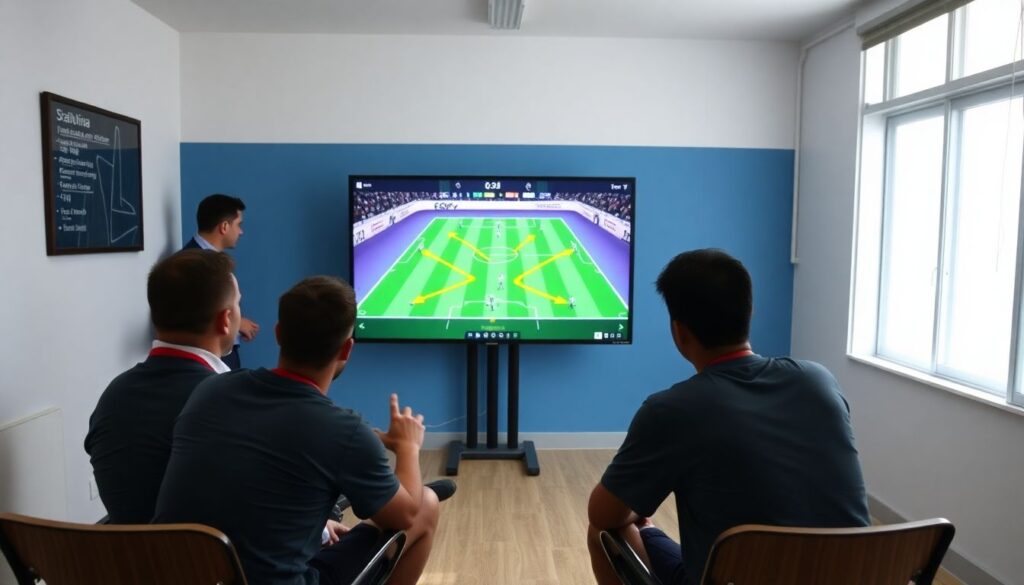
Before investing heavily, consider controlled alternatives and complements, especially for smaller Brazilian clubs or academies.
- Enhanced video and board sessions – Use multi‑angle clips, telestration, and guided questioning. This is low‑cost, scalable, and can already improve tactical understanding for many athletes.
- Field‑based perception-action games – Small‑sided games with strict constraints (touch limits, zones, triggers) reproduce many benefits of VR decision training without hardware.
- Desktop "2D VR" solutions – Interactive video on computers or tablets, where athletes pause and choose options, can mimic parts of VR decision practice at a fraction of the cost.
- Mixed reality with lighter wearables – For some sports, simple AR glasses or projection systems may be enough to overlay tactical cues on the real field with less motion sickness risk.
Evidence level for these alternatives: expert consensus and practical case reports from clubs that lack full VR infrastructure.
Practical questions coaches and performance staff raise
How many VR sessions per week are safe for team sport athletes?
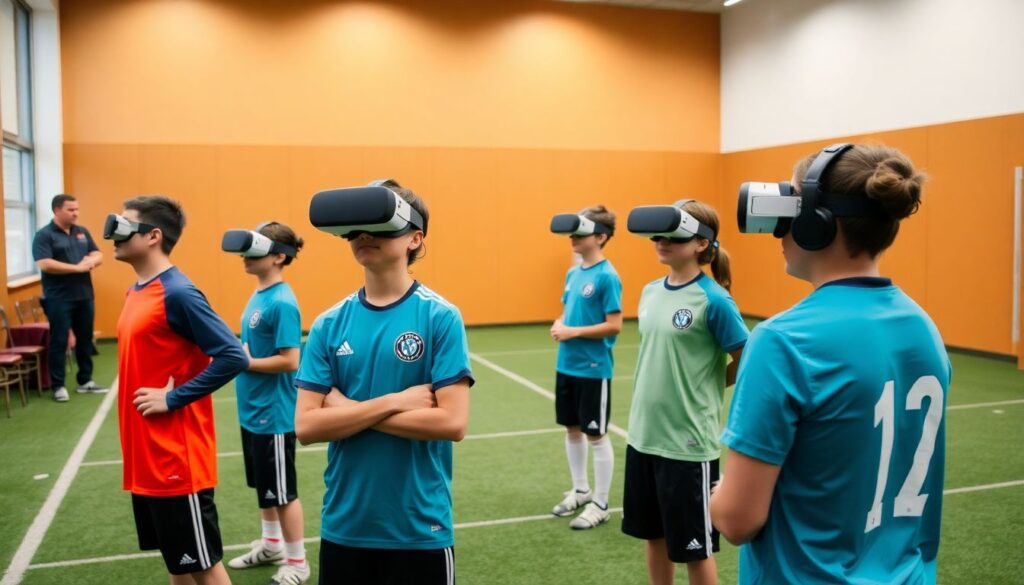
Most squads start with 1-2 short VR sessions per week and adjust based on symptoms, motivation, and tactical needs. Increase frequency gradually, especially with younger players or those prone to motion sickness.
Should injured players use VR while they cannot train on the field?
Yes, when approved by medical staff, VR can maintain tactical sharpness and engagement without impact. Keep sessions short, use low‑intensity scenarios, and monitor for headaches or eye strain that could slow recovery.
Do we need eye‑tracking and full motion capture to get value from VR?
No. For most clubs, simple head‑tracked óculos de realidade virtual para atletas plus good scenarios already deliver tactical benefits. Add eye‑tracking or motion capture only if you have clear questions they will help answer.
How do we deal with athletes who dislike or fear VR?
Start with very short, low‑motion experiences and give them control over stopping. Offer non‑VR tactical options in parallel, and never punish refusal. Over time, many athletes accept VR once they feel safe and understand its purpose.
Can VR replace traditional tactical training and match analysis?
No. VR should complement, not replace, field sessions and video meetings. Use VR to rehearse specific patterns under time pressure, while maintaining regular tactical drills, match review, and team discussions.
What is the minimum investment to pilot VR in a Brazilian club?
You can start with one mid‑range headset, basic software de realidade virtual para preparação esportiva, and a small safe room. Focus on one or two positions and tactical themes first, then scale if you see clear transfer to competition.