Mental health in elite sport requires daily, low-risk habits: clear limits on training load, early detection of stress and fatigue, and simple coping routines you can apply even on travel or competition days. Combine personal strategies with team policies and access to qualified help to reduce pressure and prevent burnout.
Immediate action checklist for athlete mental resilience
- Schedule one weekly 15-20 minute check-in to reflect on stress, mood and sleep.
- Agree with coach on a simple signal to reduce load when you feel overwhelmed.
- Define a pre-competition routine that includes at least one calming practice (breath, music, visualization).
- Limit late-night screen exposure on at least three nights before key competitions.
- Identify one trusted person (staff, teammate, family) to contact when pressure spikes.
- Keep a short list of local and online mental health services accessible on your phone.
Identifying pressure triggers specific to elite performance
Working on saúde mental no esporte de alto rendimento starts with mapping where pressure actually comes from. This approach suits professional and semi-professional athletes, coaches, and staff in Brazilian high-performance contexts, especially where media and family expectations are intense.
Do not rely only on self-monitoring if you already have severe symptoms like suicidal thoughts, self-harm, substance abuse escalation, or complete training breakdown; in these cases, seek immediate medical and psychological support instead of only using the steps below.
Quick mapping of pressure sources
- List the last five moments you felt strong pressure in training or competition.
- For each, note:
- Where you were (venue, travel, home).
- Who was involved (coach, teammates, family, press, social media).
- What was at stake (selection, contract, ranking, scholarship).
- What you told yourself mentally just before stress peaked.
- Mark with a star the two situations that repeat most often.
Common elite-level trigger categories
- Selection and contracts: fear of being cut from the team or losing income.
- Public exposure: social media attacks, live TV mistakes, hostile crowds.
- Internal expectations: perfectionism, fear of disappointing family or club.
- Role conflict: juggling studies or work with training demands.
- Injury and return-to-play: uncertainty about form, pain, and re-injury.
Screening questions you can ask yourself
- “In which exact moments does my heart rate and muscle tension rise before I even start to perform?”
- “Whose opinion scares me the most when I compete?”
- “What do I imagine will happen if I fail today?”
- “When do I start to overthink results instead of focusing on actions?”
Use these answers later to personalize coping tools and to guide conversations with a psicólogo do esporte para atletas profissionais.
Detecting and tracking early burnout indicators
Effective tratamento de burnout em atletas de alto rendimento depends on noticing signs early, before total collapse. You do not need expensive tools; simple tracking with paper, a basic app, or spreadsheets is enough if used consistently.
Core symptoms to monitor weekly
- Persistent physical fatigue not relieved by usual rest.
- Loss of motivation for training or competition you normally enjoy.
- Increased irritability with coaches, teammates, or family.
- Sleep changes: trouble falling asleep, frequent waking, or oversleeping.
- Performance inconsistency not explained by technical or tactical factors.
- Frequent minor illnesses or slow recovery from small injuries.
Simple 0-3 daily self-rating system
Every night, quickly rate the following items from 0 to 3, where 0 = “no problem” and 3 = “severe problem”:
- Physical fatigue at the end of the day.
- Mental exhaustion / difficulty concentrating.
- Motivation to train the next day.
- Sleep quality last night.
- Muscle soreness or pain today.
If any item stays at 2-3 for more than a week, share the data with your coach or medical staff and consider professional assessment.
Low-resource monitoring options for clubs
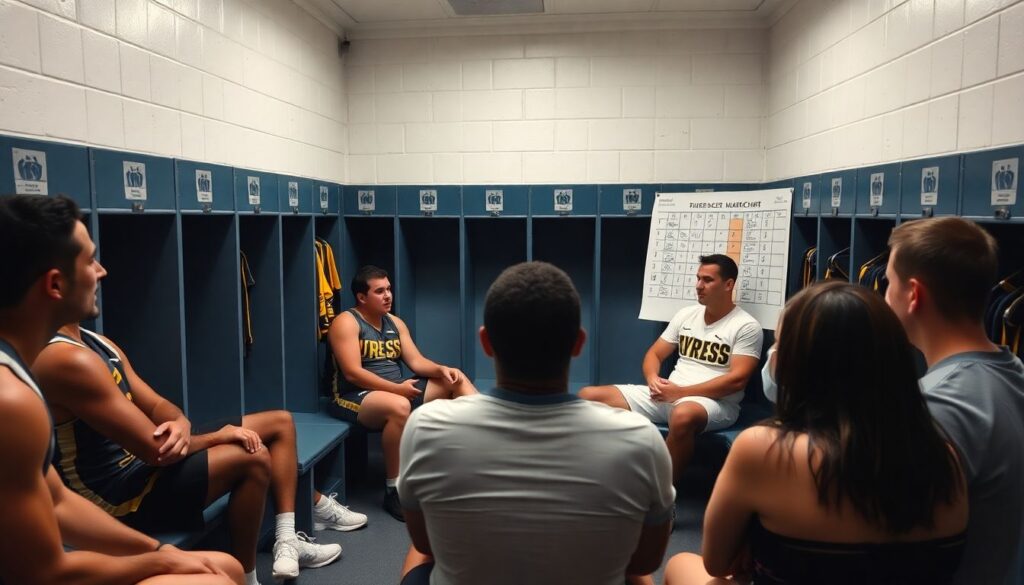
- Paper-based mood and fatigue chart posted in the locker room, filled in anonymously with daily averages.
- Free messaging app survey with three quick questions each morning.
- Group check-in circle once a week to verbalize stress level and energy (scale 0-10).
Clubs can embed these tools into broader programas de saúde mental para clubes e equipes esportivas, adjusting to age, sport, and competition level.
Designing individualized coping protocols and routines
Before building your step-by-step coping protocol, prepare these basic elements so the process stays safe and realistic.
- Clarify current diagnosis or medical guidance, if any, with your health provider.
- Ensure your main coach knows you are implementing new routines (no details needed, just alignment).
- Set aside two short weekly sessions (15-25 minutes) to practice mental skills when you are not exhausted.
- Decide in advance which strategies you will stop using if they clearly worsen your sleep or anxiety.
- Define your priority situations. Choose 1-2 specific scenarios where you most need help (for example, penalty kicks, selection trials, media interviews). Focusing on fewer situations first makes it easier to measure progress safely and avoids overwhelming change.
- Choose one primary calming technique. Start with methods that are low risk and easy to learn:
- Slow breathing (inhale 4 seconds, exhale 6 seconds) for 2-3 minutes.
- Grounding with five senses (name 5 things you see, 4 you feel, 3 you hear, 2 you smell, 1 you taste).
- Short muscle tension-release (tense a muscle group for 5 seconds, then relax 10 seconds).
Test each for a week in low-pressure settings, then keep the one that feels most natural.
- Build a micro pre-performance routine. Combine 3-5 elements you can execute consistently:
- One body action (stretch, specific warm-up move, posture reset).
- One mental cue (“focus on the next play”, “trust my preparation”).
- One calming breath or grounding cycle.
- One brief visualization of successful execution.
Keep the total duration under two minutes so it fits even into intense competitive environments.
- Plan a safe post-training decompression. Right after demanding sessions or games, include:
- 2-5 minutes of slow breathing or stretching away from noise.
- Short reflection: “What did I control well? What can I adjust next time?”
- Limit immediate review of social media or online comments about performance.
This helps your nervous system shift from high activation to recovery instead of staying in constant alert.
- Set clear boundaries around rest and technology. Agree with yourself on:
- A latest time to stop checking messages or match comments at night.
- At least one daily tech-free block (30-60 minutes) for offline recovery.
- Non-performance activities that genuinely relax you (music, reading, nature, conversation).
These boundaries are crucial when learning como lidar com pressão psicológica no esporte competitivo in the long term.
- Document and review your protocol. Write your routine in simple bullet points and keep it in your locker or phone. After two to four weeks, review:
- What you actually used in real pressure situations.
- What felt complicated or unnatural.
- Any changes in anxiety level, sleep, or performance focus.
Adjust by removing steps you never use and strengthening those that help most.
- Coordinate with a sport psychologist when possible. Share your notes with a psicólogo do esporte para atletas profissionais to refine techniques, especially if you compete internationally or face chronic stressors. They can help adapt tools to travel, time zone changes, and cultural demands in Brazilian elite sport.
Applying team-level load management and transparent communication
Use this checklist to verify whether your team or club environment supports mental health and helps prevent burnout.
- Training and competition calendars are visible to athletes at least several weeks ahead, reducing last-minute surprises.
- There is a mechanism to adjust individual training load based on fatigue and mood reports, not only performance metrics.
- Coaches openly communicate the criteria for selection and playing time, reducing uncertainty and speculation.
- Regular team meetings include short discussions about stress, travel fatigue, and recovery-not only tactics.
- Athletes know exactly whom to contact in the club when mental health concerns arise (not just physical injuries).
- Time off after high-stakes tournaments is respected and not filled with extra marketing, media, or informal practices.
- Younger athletes and academy players have age-appropriate explanations about pressure, mistakes, and learning.
- Feedback conversations focus on specific behaviors and decisions, avoiding personal attacks or humiliation.
- Any programas de saúde mental para clubes e equipes esportivas are evaluated at least once per season with athlete input.
- Staff behavior models healthy boundaries (visible rest, family time, respecting days off), showing that recovery is valued.
Embedding mental skills training within physical practice
Integrating mental training into daily sessions is powerful but can fail if implemented carelessly. Avoid these common mistakes.
- Introducing too many psychological tools at once, confusing athletes and diluting practice quality.
- Leaving mental exercises only for “crisis days” instead of small, regular doses in normal training.
- Using mental skills as punishment (“you were anxious, now you must do extra breathing drills”).
- Ignoring individual differences in learning style, assuming one visualization or cue works for everyone.
- Skipping debriefs after mental experiments, so athletes cannot link techniques to performance changes.
- Overcomplicating language, using clinical jargon players and coaches in Brazil may not understand.
- Failing to coordinate between physical coach, head coach, and psychologist, causing contradictory instructions.
- Expecting immediate performance jumps and abandoning tools when results take time to show.
- Practicing concentration only in quiet environments, never simulating crowd noise, travel fatigue, or referee mistakes.
- Not protecting psychological safety: asking athletes to share personal issues in front of the whole team without consent.
Structured transition and recovery plans after peak competition
Post-competition periods are high risk for mood drops and burnout. Here are alternative formats for structured transition and recovery plans, adaptable to different realities and budgets.
Option 1: Minimalist self-managed recovery plan
Suitable when there is little staff support or for individual athletes in smaller clubs.
- Schedule at least several full days away from sport-specific training after a major tournament or championship.
- Plan in advance 2-3 non-sport activities that bring joy and sense of identity beyond performance.
- Use a short daily check-in for mood, sleep, and energy; seek help if low mood or exhaustion persists.
Option 2: Club-led structured decompression week
Works for professional teams that can adjust calendars.
- First days: light physical sessions, no tactical intensity, no heavy video review.
- Midweek: small-group conversations about emotional experiences of the competition, facilitated by staff.
- End of week: collaborative planning of goals for the next phase, including mental skill priorities.
Option 3: Specialist-guided transition program
Ideal for teams with access to a multidisciplinary staff and where pressure and media exposure are extreme.
- One or more sessions with a sport psychologist or counselor focusing on meaning, identity, and coping with outcomes.
- Medical screening for accumulated fatigue, pain, and sleep issues before restarting heavy training.
- Family inclusion when appropriate, to align expectations and support at home.
Option 4: Peer support circles for high-pressure squads
Useful when formal resources are limited but team cohesion is strong.
- Small voluntary groups meet to discuss highs and lows, normalizing emotional responses.
- Basic ground rules: confidentiality, no judgment, equal speaking time.
- Facilitators receive simple training from local mental health professionals or online resources when possible.
Targeted answers to common implementation hurdles
How can I start if my club has no formal mental health program?
Begin with basic self-monitoring of mood, sleep, and fatigue, and one simple breathing or grounding technique. Share your routine with a trusted coach or teammate and gradually encourage others to adopt similar habits without waiting for a full program.
What if my coach does not value mental training?
Frame mental skills as performance tools: better focus, faster recovery after mistakes, and more consistent execution under pressure. Demonstrate small gains from your own routine and suggest short, low-cost experiments inside existing drills instead of asking for extra time.
When should I seek professional help instead of managing alone?
Seek a qualified professional if you experience persistent sadness, strong anxiety, panic attacks, thoughts of self-harm, dependence on substances, or if daily life outside sport becomes hard. Combine individual strategies with clinical support; do not rely only on self-help in severe cases.
How can I protect my mental health during social media attacks?
Limit screen exposure before and after games, delegate account management during peak periods if possible, and set clear rules for when you do and do not read comments. Use support from staff, teammates, and family to maintain perspective on online criticism.
What if I feel guilty asking for load reduction?
Remember that early adjustment of training can prevent injuries and burnout, protecting the team's long-term performance. Use objective data from your self-ratings on fatigue and mood to discuss changes with coaches, making the conversation about performance sustainability, not weakness.
How can small clubs in Brazil create low-cost mental health support?
Start with simple routines: group check-ins, basic psychoeducation sessions using free materials, and partnerships with local universities that train psychologists. Encourage peer support among athletes and protect time off after major competitions, even if financial and structural resources are limited.
Can I apply these strategies if I already receive therapy?
Yes, but coordinate with your therapist or sport psychologist so techniques are consistent. Share your training context and routines; they can help adapt coping tools to your schedule, travel demands, and the specific pressure patterns of your sport.