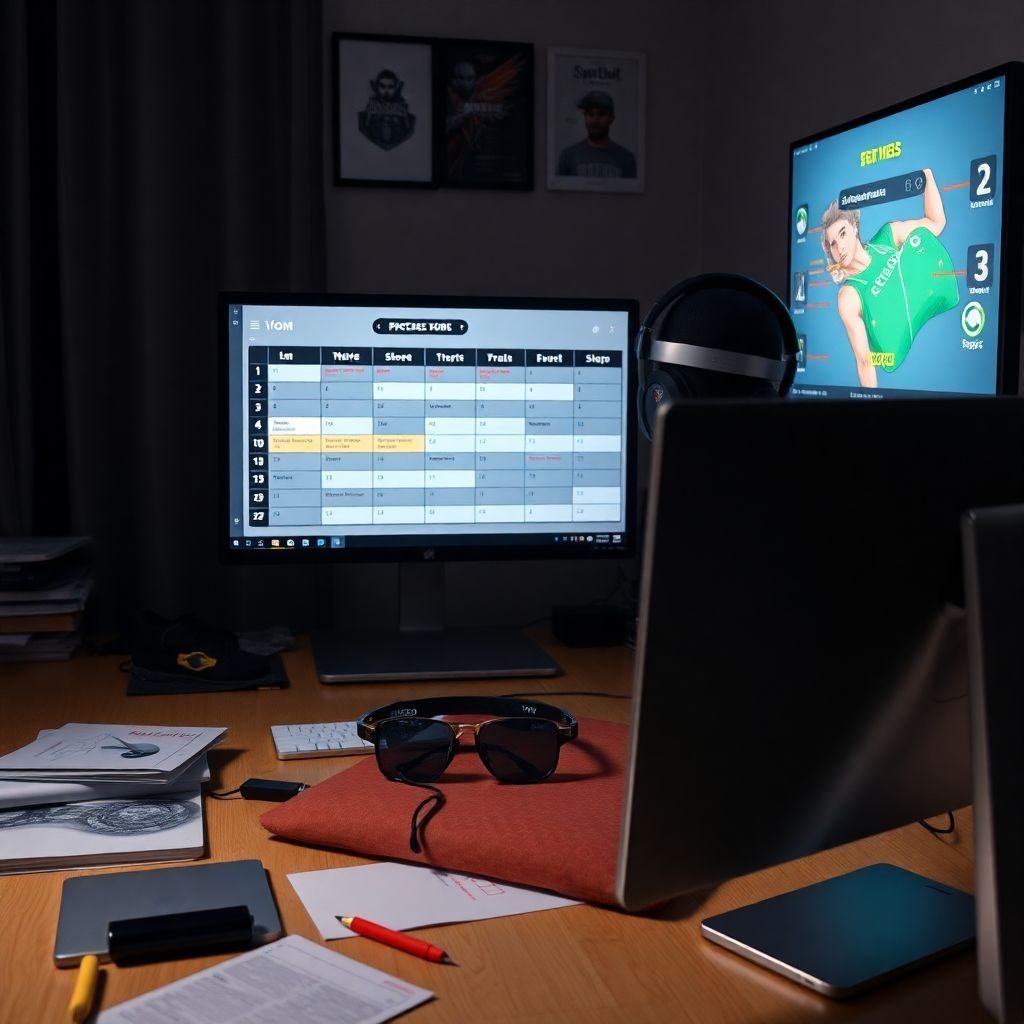
Use pro e-sports methods as a simple daily system: short warm-up, focused blocks, clear goals, basic physical care, and regular review. This guide translates treino para jogadores de e-sports profissional into safe, practical routines you can run at home, ideal for Brazilian players balancing studies, trabalho and ranked grind.
Essential Principles from Pro E‑Sports Training
- Always warm up hands, eyes and brain for 10-20 minutes before ranked or scrims.
- Train skills in small, focused blocks (aim, decision-making, communication) instead of only playing matches.
- Use simple metrics (accuracy %, reaction time, VOD notes) to track improvement weekly.
- Protect sleep, posture and basic mobility as part of any programa de condicionamento físico para gamers.
- Alternate heavy and light days (microcycles) instead of trying to push maximum intensity every session.
- Review games and adjust your plan, like a short consultoria de performance para atletas de e-sports.
- Practice structured team communication and tilt control, not only mechanics.
Daily Warm-up and Motor Skill Drills
This routine is for intermediate players who already know their main game and roles, and want to bring consistency closer to a treino para jogadores de e-sports profissional. Skip or shorten if you are injured, extremely tired, or after very long work/school days to avoid overuse.
Pre-session checklist (5-10 minutes)
- Hydrate: drink some water before touching mouse/keyboard.
- Posture: adjust chair height, monitor distance, and feet flat on the floor.
- Environment: close unnecessary apps, silence notifications, stabilize internet.
- Goal: write one clear focus (e.g., crosshair placement, minimap awareness).
- Timer: set a 20-30 minute warm-up block, separate from ranked.
Warm-up block (15-25 minutes total)
- Hand and finger activation (3-5 minutes)
- Wrist circles: 10 slow circles each direction per hand.
- Finger extensions: open and close fists 20-30 times, gently stretching.
- Forearm stretch: hold 20-30 seconds per side, no pain.
- Mouse accuracy routine (8-12 minutes)
- Aim trainer or in-game range: 3-4 runs of 2-3 minutes.
- Focus on smoothness and consistent crosshair height, not raw speed.
- Checkpoint: by the last run, you should feel controlled, not tense.
- Game-specific drill (5-8 minutes)
- MOBA: last-hitting only, or custom last-hit and movement practice.
- FPS: spray control wall practice; track 10-15 sprays per weapon.
- Checkpoint: one small improvement (more CS, tighter spray) versus yesterday.
Caveat: if hands feel numb, painful, or you need force to move fingers, stop and rest; no drill is worth injury.
Cognitive Conditioning: Attention, Decision Speed and Working Memory
To bring a curso de treinamento para pro player de esports online into your routine, you only need simple tools and consistency, not expensive software.
Preparation: tools and setup
- Device: PC, notebook or smartphone capable of running basic cognitive apps and your main game.
- Software (pick 1-2):
- Free aim trainer or reaction-time website.
- Simple dual-task apps (e.g., number/colour games) or custom maps that force multitasking.
- Note app or notebook to log scores (reaction ms, correct answers, mistakes).
- Network: stable connection to avoid lag when training in-game decision-making.
- Time block: 10-20 minutes before or after mechanics warm-up, 3-5 times per week.
Core mental routines (examples)
- Focused attention drill (5-8 minutes)
- Use a reaction-test site or aim trainer mode that punishes early clicks.
- Goal: maintain similar reaction time and accuracy across 5 short runs.
- Decision speed under constraints (5-10 minutes)
- In your game, run custom scenarios: 1v2 clutch setups, limited time macro decisions.
- Ask after each rep: what 1 info was missing, what would you check first next time?
- Working memory mini-game (3-5 minutes)
- Number sequence apps, card-order games, or self-made routine: remember 3-5 calls (timers, summoners, utility cooldowns).
- Goal: increase difficulty only when you can complete 3 rounds with minimal errors.
Caveat: avoid stacking too many cognitive drills right before sleep; some players feel over-stimulated and sleep worse.
Physical Fitness, Sleep and Recovery Protocols for Gamers
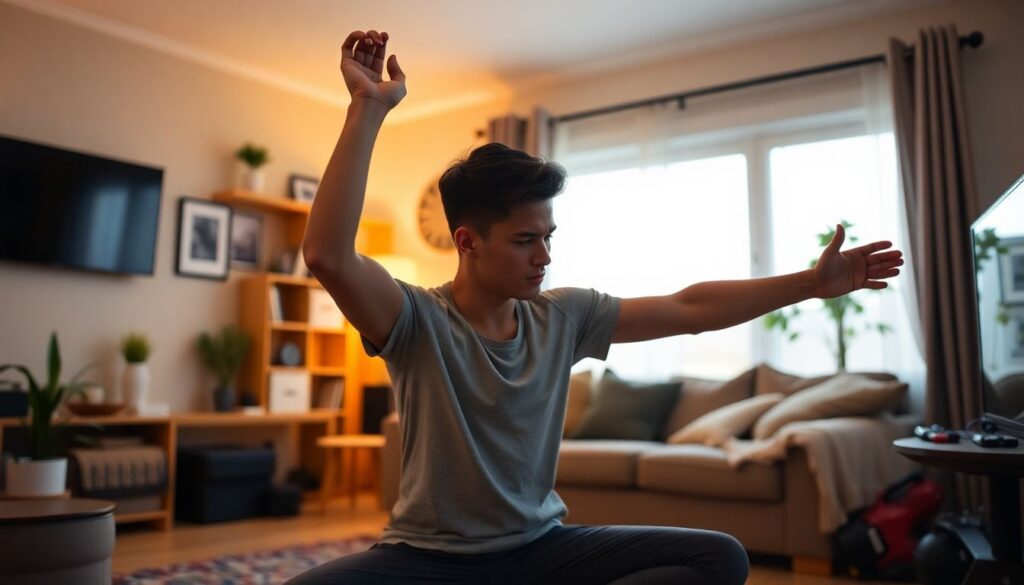
This section turns a basic, safe programa de condicionamento físico para gamers into a clear step-by-step routine. Keep intensity moderate, respect pain signals, and talk to a health professional if you have previous injuries or medical conditions.
Pre-training safety checklist
- No sharp pain in joints (wrists, shoulders, knees, back) at rest.
- You slept at least roughly 7 hours in the last 24 hours.
- You ate something light in the last 2-3 hours (not in complete fasting).
- Enough space around chair/desk to stand, stretch and lie on the floor safely.
- If you feel dizzy, short of breath, or with chest pain at any moment, stop immediately.
- Daily mobility reset (5-10 minutes)
Do this once per day, ideally before or after your main gaming block.- Neck: slow side bends and rotations, 5-8 per direction, pain-free range only.
- Thoracic spine: seated rotations, 8-10 per side holding chair.
- Hips and hamstrings: gentle hip hinge and lunge stretch, 20-30 seconds per side.
- Checkpoint: posture feels easier and shoulders less tense when you sit back down.
- Strength basics 2-3x per week (10-20 minutes)
On non-consecutive days, run a short full-body routine at home.- Squats to chair: 2-3 sets of 8-12 reps, controlled tempo.
- Wall or knee push-ups: 2-3 sets of 6-10 reps, no pain in wrists/shoulders.
- Glute bridge on floor: 2-3 sets of 10-15 reps, hold 2 seconds at top.
- Checkpoint: slight muscle fatigue is normal; any joint pain means stop and reduce difficulty.
- Light cardio for circulation (10-15 minutes)
Choose low-impact options you enjoy, 3-5 times per week.- Brisk walk, stationary bike, or dancing at home.
- Keep intensity so you can still talk in short sentences.
- Checkpoint: you feel slightly warm and breathing a bit faster, but not exhausted.
- Micro-break protocol during gaming (1-3 minutes every 45-60 minutes)
Schedule short breaks to protect hands, eyes and back.- Stand up, roll shoulders 10 times, walk around room.
- Wrist and finger stretch: 15-20 seconds each, no bouncing.
- Eye break: look at an object far away for 20 seconds.
- Checkpoint: set a timer or use in-game queue times as natural break markers.
- Sleep and wind-down routine (20-40 minutes before bed)
Treat this like your nightly consultoria de performance para atletas de e-sports with yourself.- Last ranked game at least 30-45 minutes before bed.
- Dim lights, avoid heavy food and intense discussions about tilt.
- Do 2-5 minutes of deep breathing or gentle stretching.
- Checkpoint: you fall asleep easier and wake up less tired after a week of consistency.
Caveat: increase time or intensity slowly over weeks; sudden jumps in volume often cause pain and demotivation.
Session Design: Periodization, Intensity and Microcycles
Use this checklist to design your weekly training like a simplified curso de treinamento para pro player de esports online, adapted to work or university schedules in Brazil.
- You defined 1-2 main goals for this week (e.g., positioning, aim consistency, macro decisions).
- Your week includes at least 1 lighter day (reduced volume or lower ranked intensity).
- Each gaming day has a 15-30 minute warm-up separated from ranked or competitive matches.
- You limit most sessions to a maximum number of serious matches (for example, 5-7 ranked games) before a break or review.
- You plan at least 2 short VOD review blocks of 15-20 minutes during the week.
- Heavy days: higher focus on ranked/scrims; you still stop if performance drops for several games in a row.
- Light days: focus more on aim training, custom games, communication drills, and physical recovery.
- Once per week, you adjust next week’s goals based on notes, not on emotion from one bad night.
- You track simple metrics (win/loss, KDA, farm, damage, utility usage) to see trends across weeks.
- You accept that rest days are part of periodization, not a sign of weakness or laziness.
Data-driven Feedback: Metrics, Review and Adjustment Routines
Borrow the structure that the melhor coach de e-sports para melhorar desempenho would use, but keep it lightweight and realistic.
- Tracking too many stats at once, making the process so complex that you stop after a few days.
- Reviewing only wins or only losses, instead of looking at both to find patterns.
- Blaming teammates in every note, which prevents you from seeing your own consistent mistakes.
- Skipping VOD review completely and trying to remember plays only from memory.
- Watching full matches without pausing or writing anything, turning review into passive entertainment.
- Changing sensitivity, keybinds or champions frequently, making metrics impossible to compare.
- Adjusting your whole training plan after one bad session, instead of waiting for several data points.
- Ignoring physical or mental state when reading stats (tilt, tiredness, outside stress).
- Comparing your numbers only with pro players instead of your own past weeks.
- Not defining what “improvement” means beforehand (fewer deaths, more consistent CS, better utility usage).
Team Routines: Communication, Role Practice and Mental Resilience
Not everyone has access to a full team or melhor coach de e-sports para melhorar desempenho. These alternatives keep team skills growing in realistic Brazilian conditions.
- Structured duo or trio queue
If you do not have a full team, create fixed duos/trios with clear roles and review 10-15 minutes after sessions. Use basic call frameworks (info, plan, confirmation). This is ideal when schedules vary but you still want consistent partners. - Community or academy teams
Join local groups, community tournaments or small org academies that mimic pro structure with scrims and simple playbooks. This works when you want more discipline but cannot commit to full-time practice. - Solo queue with communication goals
Even alone, set targets: first call at start of round, call own mistakes, avoid blaming. Treat solo as mental resilience training: staying calm across 3-5 games regardless of teammates’ behaviour. - Remote coaching and peer review
If formal consultoria de performance para atletas de e-sports is too expensive, try occasional paid sessions or free peer VOD review groups. Good when you need outside perspective without a permanent team structure.
Practical Concerns and Rapid Solutions for Implementation
How many hours per day should I train using these methods?
Focus on quality before quantity: start with 60-120 minutes including warm-up, drills, and games. Only increase time if you stay focused, keep school or work stable, and do not feel constant fatigue or pain.
Can I follow this routine if I only play on console or mobile?

Yes. Adapt aim and movement drills to your device and game, and keep the physical, sleep and mental routines the same. The structure works for any competitive title, not only PC shooters or MOBAs.
Do I need a paid course or coach to see improvement?
No. This guide covers much of what a basic curso de treinamento para pro player de esports online offers. A coach can speed up learning, but only if you already apply consistent daily habits and track your progress.
What should I do if I start feeling wrist or back pain?
First, reduce volume and intensity, and stop any movement that causes sharp pain. If pain persists, see a health professional in Brazil (physio or doctor) before returning to full training, and prioritize ergonomics and micro-breaks.
How do I balance training with school, faculdade or work in Brazil?
Use short, focused blocks: 20-30 minutes warm-up plus 2-4 serious games on weekdays, then longer sessions on weekends if energy allows. Protect sleep and studies first; long-term progression is impossible if your life is always overloaded.
How soon can I expect visible improvement from this plan?

With consistent application 4-6 days per week, many players notice more stability and fewer “tilt games” within a few weeks. Deeper rank changes can take longer; judge success mainly by better decisions and fewer repeated mistakes.
What if my friends or team do not want to train seriously?
Apply the structure to your solo routine and look for people who share your goals in communities and ranked. You cannot force others to train, but your own discipline often attracts more serious teammates over time.