
Why online sports promos in 2026 look so attractive – and so dangerous
Online betting promos have never been as aggressive as in 2026. Competition between brands, arrival of new regulators and cheaper customer-acquisition tech created a promo arms race: boosted odds, insured bets, “risk‑free” parlays, weekly reloads. On the surface, it looks like free money; in practice, most users turn these offers into losses faster than with normal bets. The gap between marketing promise and mathematical reality is exactly where traps hide, and where a prepared bettor can still find genuine value.
—
How modern promos really work behind the marketing
Bookmakers see promos as a performance marketing channel with a clear KPI: cost per active customer. An offer “up to 200 EUR” is usually calibrated so that average real cost for the house stays closer to 25–40 EUR. They do it through minimum odds, rollovers, time limits and segmentation by user profile. The more aggressive the banner, the tighter the terms in the fine print. Understanding that dynamic is the first step to treating promos as tools, not gifts.
—
Reading promo terms like a pro, not like a victim
The decisive factor is not the headline bonus size, but the effective cost of unlocking it. You need to evaluate: wagering requirement, eligible markets, minimum odds and maximum real gain. For example, a 100% match with 10x rollover at minimum odds 1.80 is drastically worse than a 50% match with 3x rollover at 1.50. The paradox is that casual users usually chase the larger number, while value‑oriented bettors prefer offers that look modest but can realistically be cleared with acceptable risk.
—
Technical details: quick checklist for any promo
– Check total turnover: bonus + deposit or only bonus
– Confirm minimum odds and excluded markets (e.g., handicaps, player props)
– Look for time limits and max payout caps
– Identify if cashout voids the promo or counts to wagering
– See if the bonus is sticky (cannot be withdrawn) or cash once requirements are met
When this checklist becomes automatic, spotting toxic structures takes seconds.
—
Real‑world example: when a “risk‑free bet” is not risk‑free
Imagine a 50 EUR “risk‑free” single. If you lose, you get 50 EUR back in bonus funds with 5x wagering at minimum odds 1.70. In practice, losing the first bet is almost a prerequisite for extracting value, but the subsequent rollover pushes you to place 250 EUR in qualifying stakes, usually on markets with higher margins. Data from mid‑sized European books shows that more than 70% of users who receive this type of offer either bust the bonus or stop halfway, leaving the theoretical EV on the table and converting the “risk‑free” slogan into plain extra volume for the house.
—
Welcome bonuses: the most overestimated “opportunity”
The most common trap in 2026 remains the classic signup package. That shiny banner of *bônus de boas-vindas apostas esportivas online* hides an acquisition funnel optimised for maximum early churn. Multi‑step registration, KYC checks and tight deadlines often push new users to rush their first bets, over‑stake and ignore odds value. In internal case studies shared by affiliates, it’s common to see that only 20–30% of new players ever complete full wagering, while the house already locked in margin on every forced qualifying stake.
—
Technical details: measuring bonus “real value”
A pragmatic way to compare offers is to approximate expected value (EV) in percentage of deposit. Roughly, you can think in three layers: immediate value (freebet size or match rate), friction (rollover, odds limits, time) and structural edge (bookmaker margin). An offer with 30% theoretical EV but high variance might be worse for a modest bankroll than a 10% EV promo with low variance. Serious bettors sometimes even model this in spreadsheets, simulating expected bankroll trajectories under different promo strategies rather than fixating on the headline amount.
—
Ongoing promos vs one‑off boosts: where real value tends to hide
One‑time welcome deals get all the marketing, but the more interesting opportunities usually sit in weekly or event‑based campaigns: odds boosts on low‑margin markets, bet insurance on popular leagues, combo bonuses that accidentally underprice correlation. Because these promos are designed for engagement, not just acquisition, their terms are sometimes more relaxed. A small but repeatable +3–5% edge each weekend can outperform a single huge but toxic signup package over a few months, especially for disciplined bankroll managers.
—
Identifying fair promos: practical markers to look for
To filter noise, you need clear markers of fairness. Reasonable rollover (3–5x), flexible market selection, realistic timeframes and transparent communication are usually good signs. Bookmakers that rely on confusing wording, hidden exclusions or interface dark‑patterns often carry the same mindset into their support and risk management. Over time, profiles who prioritise user lifetime value tend to become the casas de apostas com melhores promoções esportivas, not because they are generous, but because they design promos compatible with sustainable play instead of one‑off extraction.
—
Checklist: signs of a genuinely good offer
– Wagering requirement below 6x and counting both bonus and deposit turnover clearly
– Minimum odds not much higher than 1.60–1.70 for main lines
– No obscure exclusions like “no live bets on top leagues” hidden deep in rules
– Bonus credited quickly and tracked in a visible, transparent wallet
– Support able to explain the rules without contradictions
If two or three of these fail, treat the promo as entertainment, not a profit tool.
—
Rollover: the silent killer of seemingly generous promos
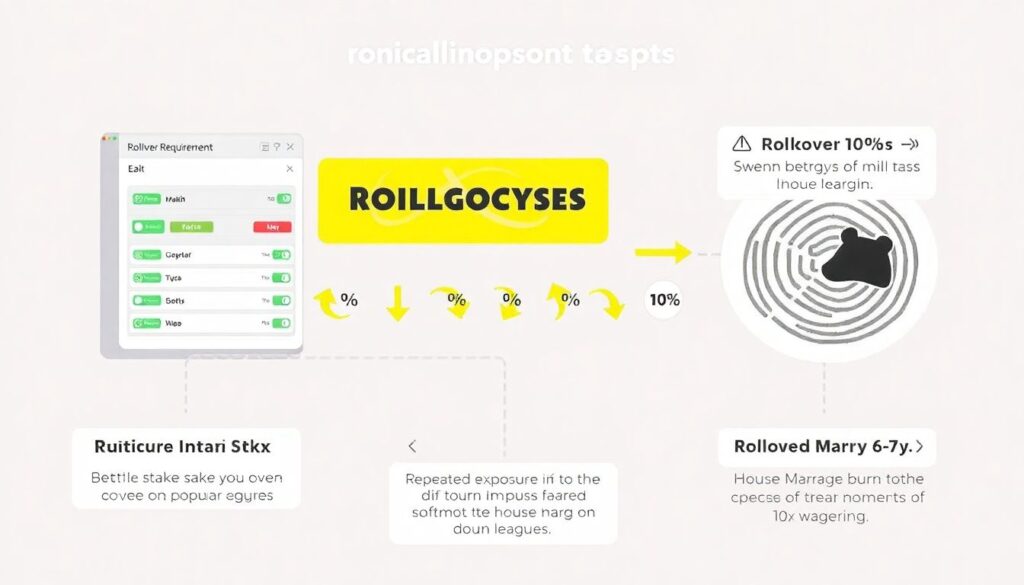
Rollover is where most traps live. Every extra turn of your stake through the sportsbook subjects you again to the house margin. A standard margin of 6–7% on popular leagues means that a 10x wagering requirement effectively burns a huge portion of the promo’s nominal value. This is why experienced players actively search for promoções apostas esportivas sem rollover abusivo, even if that means smaller raw amounts. Clearing a 2x or 3x bonus in a few well‑selected markets beats endlessly churning through marginal lines to satisfy a bloated requirement.
—
Technical details: how rollover eats expected value
A simplified way to see it: suppose average margin is 6% and you must wager 8x your bonus + deposit. Roughly, each full turnover costs you 6% of the amount bet in expectation. After 8 cycles, the compounded drag is enormous, and the initial “free” funds are largely offset by built‑in disadvantage. The house calibrates exactly this interaction when deciding how big a headline number they can advertise without turning the promo into a net loss maker.
—
Comparing sites: why tools and spreadsheets beat intuition
In 2026, you no longer have to manually scan dozens of brands. Aggregators and odds‑comparison platforms increasingly include promo intelligence: effective value estimates, user feedback on payout behaviour and detection of predatory clauses. Still, the final decision is yours. When you comparar bônus e promoções de casas de apostas, basic discipline helps: write down conditions, approximate EV, check reputation and risk limits. Two offers that look similar in size can differ massively once you factor real rollover, odds floor and historical treatment of winning customers.
—
Freebets and cashback: softer promos with interesting edges
While headline deposit matches get more attention, the melhores sites de apostas com freebet e cashback often provide more transparent, lower‑variance value. Cashback on net losses up to a modest cap effectively reduces variance and house edge for recreational bettors, especially when it comes in cash rather than bonus funds. Freebets, if structured as “stake not returned”, still carry positive EV when used on properly priced underdogs. The key mistake is burning them on emotional picks instead of spots where your own handicapping suggests a true price shorter than the market.
—
Case study: two offers, one smart choice
Consider two fictional operators. Book A offers 100% up to 300 EUR with 12x rollover at odds 1.90, 14‑day limit. Book B offers 50% up to 150 EUR with 3x rollover at odds 1.60, 30‑day limit plus 10 EUR freebet on completion. Many newcomers jump to Book A because “300 > 150”. In practice, the probability that a small bankroll clears 12x without busting is low, and stress levels are high. Over a season, disciplined players usually end up net positive with structures like Book B, where you can integrate qualifiers into your normal betting strategy instead of distorting it.
—
Risk management: using promos without destroying your bankroll
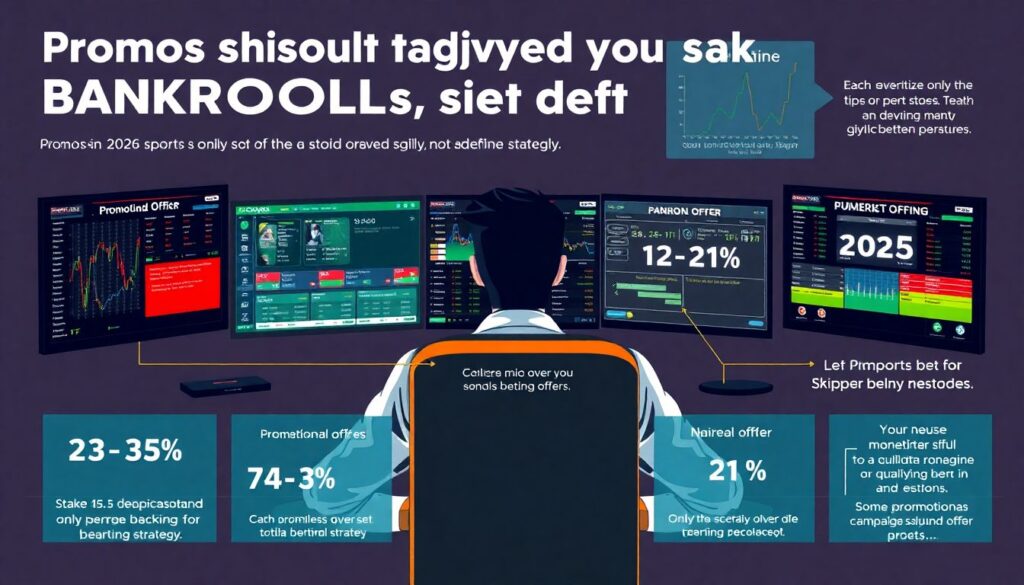
Promos should adjust your staking slightly, not define it. In 2026, the most successful semi‑pro bettors treat each offer as an overlay on top of their base edge. They rarely exceed 2–3% of bankroll per qualifying bet, even when deadlines pressure them. They also accept skipping many campaigns entirely if the terms don’t fit their profile. A seemingly small leak—like chasing every boosted parlay—can wipe out the thin margin created by a few good promos. Consistency in stake sizing and market selection matters more than maximising promo count.
—
Technical details: integrating promos into a betting strategy
A practical model is to maintain two “buckets”: core bets based on your handicapping and promo‑driven bets that only exist to unlock value. The second bucket still follows strict limits: use only markets you understand, avoid correlated legs in parlays and stick to pre‑defined stake fractions. Track results for both buckets separately over time. If you notice that promo‑driven activity consistently underperforms, you either mis‑estimate EV or let psychological pressure from deadlines push you into poor selections.
—
Looking forward: how promo ecosystems may evolve by 2030
By 2026, regulators in Europe and parts of Latin America already pushed for clearer disclosure of promo terms, caps on bonus size and restrictions on targeting vulnerable users. Over the next few years, we can expect more standardisation: unified wording for rollover, mandatory probability labels on boosted odds and centralised self‑exclusion tools that extend across brands. At the same time, data‑driven personalisation will intensify: dynamic promos based on your risk profile, bet history and churn probability, making offers more tailored but also harder to compare at a glance.
—
Trends to watch: AI, gamification and “safer” promos
Three trends are particularly relevant. First, machine‑learning models will optimise promo timing and structure in real time, increasing psychological pressure through perfectly calibrated FOMO. Second, gamification—levels, missions, loot‑box‑style rewards—will blur lines between bonuses and game design, raising new questions for regulators. Third, there’s a slow shift towards “safer” frameworks like loss‑limited promos, where weekly caps and built‑in cool‑offs are standard. For savvy users, the challenge will be to exploit value without falling for subtle nudges baked into personalised dashboards and missions.
—
Final thoughts: turning promos into a tool, not a trap
Online sports promos are not going away; they are becoming more complex. The edge in 2026 no longer comes from spotting obviously mispriced offers, but from combining mathematical literacy, psychological awareness and rigorous record‑keeping. If you treat every campaign as a small investment decision—reading terms, estimating EV, fitting it into your bankroll plan—you can still extract meaningful value from a promo‑dense market. If you chase banners and deadlines, you will fund those who do the math more carefully.